Ch. 10 - Reactions of Alcohols, Ethers, Epoxides, Amines, and Sulfur-Containing Compounds
Bruice - Organic Chemistry 8th Edition
Bruice8th EditionOrganic ChemistryISBN: 9780135213711Not the one you use?Change textbook
Chapter 11, Problem 6a

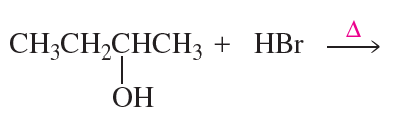
What is the major product of each of the following reactions?
a. Chemical reaction showing the reaction of an alcohol with HBr, indicating the major product formation.

Verified step by step guidance
1
Step 1: Identify the type of reaction. The reaction involves an alcohol (OH group) reacting with HCl, which is a strong acid. This is a substitution reaction where the hydroxyl group (-OH) is replaced by a halide (Cl).
Step 2: Determine the mechanism. Since the alcohol is tertiary (the carbon attached to the -OH group is bonded to three other carbons), the reaction will proceed via an SN1 mechanism. This is because tertiary carbons stabilize the carbocation intermediate formed during the reaction.
Step 3: Protonation of the alcohol. The hydroxyl group (-OH) is protonated by HCl, forming water (H2O), which is a good leaving group. This step increases the likelihood of the leaving group departing.
Step 4: Formation of the carbocation. After the water molecule leaves, a tertiary carbocation is formed. This carbocation is highly stable due to hyperconjugation and inductive effects from the surrounding alkyl groups.
Step 5: Nucleophilic attack. The chloride ion (Cl⁻) from HCl acts as a nucleophile and attacks the carbocation, forming the final product, which is a tertiary alkyl chloride.

Verified video answer for a similar problem:

This video solution was recommended by our tutors as helpful for the problem above.
Video duration:
3m
Was this helpful?

Key Concepts

Here are the essential concepts you must grasp in order to answer the question correctly.

Nucleophilic Substitution

Nucleophilic substitution is a fundamental reaction in organic chemistry where a nucleophile replaces a leaving group in a molecule. In this case, the hydroxyl group (OH) acts as a nucleophile, and when reacting with HCl, it can be substituted by a chloride ion (Cl-), leading to the formation of an alkyl chloride.
Recommended video:
Guided course
01:47
Nucleophiles and Electrophiles can react in Substitution Reactions.

Reactivity of Alcohols

Alcohols are organic compounds containing hydroxyl (-OH) groups, and their reactivity can vary based on the structure of the alcohol. In this reaction, the presence of HCl facilitates the conversion of the alcohol into a more reactive alkyl halide, which is often more favorable for further reactions, such as elimination or substitution.
Recommended video:
Guided course
01:01
How to name alcohols

Mechanism of Reaction

Understanding the mechanism of the reaction is crucial for predicting the major product. The reaction typically proceeds via a two-step mechanism: protonation of the alcohol by HCl to form a better leaving group, followed by the nucleophilic attack by chloride ion, resulting in the formation of the alkyl chloride as the major product.
Recommended video:
Guided course
02:16
Heck Reaction Mechanism