Ch. 10 - Reactions of Alcohols, Ethers, Epoxides, Amines, and Sulfur-Containing Compounds
Bruice - Organic Chemistry 8th Edition
Bruice8th EditionOrganic ChemistryISBN: 9780135213711Not the one you use?Change textbook
Chapter 11, Problem 84

Triethylene glycol is one of the products obtained from the reaction of excess ethylene oxide and hydroxide ion. Propose a mechanism for its formation.

Verified step by step guidance
1
Step 1: Recognize that ethylene oxide is an epoxide, which is a highly strained three-membered ring. The hydroxide ion (OH⁻) acts as a nucleophile and attacks the electrophilic carbon in the epoxide ring, leading to ring opening. This is a nucleophilic substitution reaction.
Step 2: The hydroxide ion attacks one of the carbons in the epoxide ring, breaking the C-O bond and forming a new hydroxyl group (-OH) on the carbon. This results in the formation of ethylene glycol (HO-CH₂-CH₂-OH).
Step 3: Excess ethylene oxide reacts further with the hydroxyl group of ethylene glycol. The hydroxyl group acts as a nucleophile and attacks another molecule of ethylene oxide, leading to the formation of diethylene glycol (HO-CH₂-CH₂-O-CH₂-CH₂-OH).
Step 4: The process repeats with another molecule of ethylene oxide reacting with the hydroxyl group of diethylene glycol. This leads to the formation of triethylene glycol (HO-CH₂-CH₂-O-CH₂-CH₂-O-CH₂-CH₂-OH).
Step 5: The reaction mechanism involves successive nucleophilic attacks by hydroxyl groups on ethylene oxide molecules, facilitated by the excess ethylene oxide and hydroxide ion. The final product, triethylene glycol, contains three ethylene glycol units connected by ether linkages.

Verified video answer for a similar problem:

This video solution was recommended by our tutors as helpful for the problem above.
Video duration:
6m
Was this helpful?

Key Concepts

Here are the essential concepts you must grasp in order to answer the question correctly.

Nucleophilic Attack

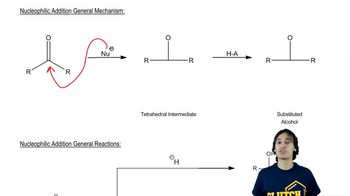
Nucleophilic attack is a fundamental reaction mechanism in organic chemistry where a nucleophile, which is an electron-rich species, attacks an electron-deficient center, typically a carbon atom in a molecule. In the case of triethylene glycol formation, the hydroxide ion acts as the nucleophile, attacking the electrophilic carbon of ethylene oxide, leading to the opening of the epoxide ring.
Recommended video:
Guided course
08:27
Nucleophilic Addition

Epoxide Ring Opening

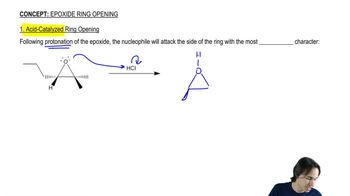
Epoxide ring opening is a specific reaction involving the cleavage of a three-membered cyclic ether known as an epoxide. This reaction can occur under acidic or basic conditions, with nucleophiles attacking the less hindered carbon atom. In the formation of triethylene glycol, the hydroxide ion opens the epoxide, allowing for the formation of a diol structure as the reaction progresses.
Recommended video:
Guided course
04:34
Acid-Catalyzed Epoxide Ring-Opening

Polymerization

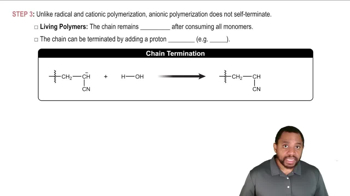
Polymerization is a chemical process where small molecules, known as monomers, combine to form larger, more complex structures called polymers. In the context of triethylene glycol synthesis, the reaction of multiple ethylene oxide units with hydroxide ion leads to the formation of a polymeric structure, resulting in triethylene glycol, which consists of repeating ethylene glycol units linked by ether bonds.
Recommended video:
1:06
Anionic Polymerization Concept 4