Ch. 10 - Reactions of Alcohols, Ethers, Epoxides, Amines, and Sulfur-Containing Compounds
Bruice - Organic Chemistry 8th Edition
Bruice8th EditionOrganic ChemistryISBN: 9780135213711Not the one you use?Change textbook
Chapter 11, Problem 78

How could you synthesize isopropyl propyl ether, using isopropyl alcohol as the only carbon-containing reagent?

Verified step by step guidance
1
Step 1: Recognize that isopropyl propyl ether is an ether, which has the general structure R-O-R'. In this case, one R group is isopropyl, and the other R group is propyl. The goal is to form this ether using isopropyl alcohol as the only carbon-containing reagent.
Step 2: Recall the Williamson ether synthesis, a common method for synthesizing ethers. This reaction involves the reaction of an alkoxide ion (R-O⁻) with a primary alkyl halide (R'-X) via an SN2 mechanism. To apply this, you need to generate an isopropoxide ion (from isopropyl alcohol) and a propyl halide.
Step 3: Convert isopropyl alcohol (CH₃-CHOH-CH₃) into isopropoxide ion (CH₃-CH⁻-CH₃) by reacting it with a strong base, such as sodium hydride (NaH) or sodium metal (Na). This deprotonates the alcohol, forming the alkoxide ion.
Step 4: Generate a propyl halide (e.g., 1-bromopropane, CH₃-CH₂-CH₂-Br) from isopropyl alcohol. This can be achieved by first oxidizing isopropyl alcohol to acetone (CH₃-CO-CH₃) using an oxidizing agent like PCC or chromic acid, followed by a reaction with a Grignard reagent (e.g., ethylmagnesium bromide, CH₃-CH₂-MgBr) to form 1-propanol. Finally, convert 1-propanol to 1-bromopropane using a halogenating agent like PBr₃.
Step 5: Perform the Williamson ether synthesis by reacting the isopropoxide ion (CH₃-CH⁻-CH₃) with the propyl halide (CH₃-CH₂-CH₂-Br). This SN2 reaction will result in the formation of isopropyl propyl ether (CH₃-CHO-CH₂-CH₂-CH₃) and a byproduct (e.g., NaBr).

Verified video answer for a similar problem:

This video solution was recommended by our tutors as helpful for the problem above.
Video duration:
8m
Was this helpful?

Key Concepts

Here are the essential concepts you must grasp in order to answer the question correctly.

Ethers and Their Synthesis

Ethers are organic compounds characterized by an oxygen atom connected to two alkyl or aryl groups. The synthesis of ethers can often be achieved through the dehydration of alcohols, where two alcohol molecules react to form an ether and water. Understanding this process is crucial for synthesizing isopropyl propyl ether from isopropyl alcohol.
Recommended video:
Guided course
03:50
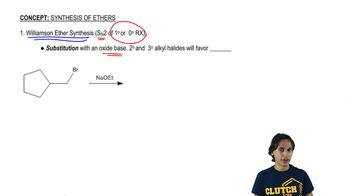
The Mechanism of Williamson Ether Synthesis.

Dehydration Reaction

A dehydration reaction involves the removal of a water molecule from the reactants, typically during the formation of an ether from alcohols. In this context, isopropyl alcohol can undergo dehydration in the presence of an acid catalyst to yield isopropyl propyl ether. Recognizing the conditions and mechanisms of dehydration is essential for successful synthesis.
Recommended video:
Guided course
01:23
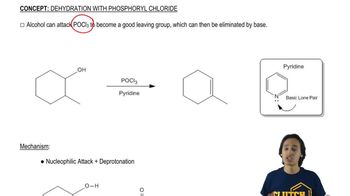
General Reaction of Dehydration with POCl3

Catalysis in Organic Reactions

Catalysts are substances that increase the rate of a chemical reaction without being consumed in the process. In the synthesis of ethers, acid catalysts such as sulfuric acid are often used to facilitate the dehydration of alcohols. Understanding the role of catalysts is important for optimizing reaction conditions and yields in organic synthesis.
Recommended video:
2:10
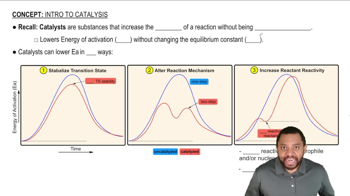
Introduction to Catalysis Concept 1