Ch. 1 - Remembering General Chemistry: Electronic Structure and Bonding (Part 2)
Bruice - Organic Chemistry 8th Edition
Bruice8th EditionOrganic ChemistryISBN: 9780135213711Not the one you use?Change textbook
Chapter 2, Problem 59c

Draw a skeletal structure for each of the compounds.
c. CH3COOH

Verified step by step guidance
1
Identify the functional groups in the compound CH₃COOH. This molecule contains a carboxylic acid functional group (-COOH) and a methyl group (-CH₃).
Understand the skeletal structure representation: In skeletal structures, carbon atoms are represented as vertices or endpoints of lines, and hydrogen atoms bonded to carbons are implied but not explicitly shown. Only heteroatoms (like oxygen) and their attached hydrogens are explicitly drawn.
Start by drawing the methyl group (-CH₃) as a single vertex connected to the next carbon atom in the chain.
Attach the carboxylic acid group (-COOH) to the second carbon. Represent the carbonyl group (C=O) as a double bond to an oxygen atom, and the hydroxyl group (-OH) as a single bond to another oxygen atom.
Double-check the structure to ensure all bonds are correctly represented and that the molecule adheres to the octet rule for each atom where applicable.

Verified video answer for a similar problem:

This video solution was recommended by our tutors as helpful for the problem above.
Video duration:
3m
Was this helpful?

Key Concepts

Here are the essential concepts you must grasp in order to answer the question correctly.

Skeletal Structures

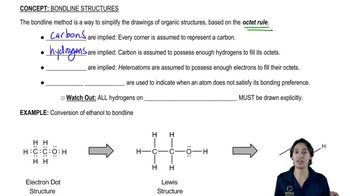
Skeletal structures, or line-angle formulas, are simplified representations of organic molecules where carbon atoms are implied at the ends of lines and intersections. Hydrogen atoms attached to carbons are usually omitted for clarity. This notation allows chemists to visualize the molecular framework quickly, focusing on functional groups and connectivity.
Recommended video:
Guided course
04:03
How bondline is different from Lewis Structures.

Functional Groups

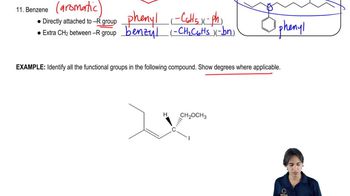
Functional groups are specific groups of atoms within molecules that are responsible for the characteristic chemical reactions of those molecules. In the case of CH3COOH, the carboxylic acid functional group (-COOH) is crucial, as it defines the compound's acidic properties and reactivity. Recognizing functional groups is essential for predicting the behavior of organic compounds.
Recommended video:
Guided course
02:36
Identifying Functional Groups

Carboxylic Acids

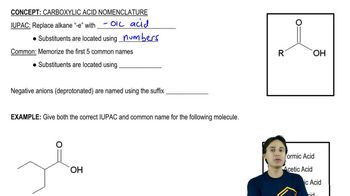
Carboxylic acids are organic compounds that contain a carboxyl group (-COOH). They are known for their acidic properties due to the ability of the carboxyl group to donate a proton (H+) in solution. Understanding the structure and properties of carboxylic acids, like acetic acid (CH3COOH), is fundamental in organic chemistry, as they are prevalent in various biological and industrial processes.
Recommended video:
Guided course
04:20
Carboxylic Acids Nomenclature