Textbook Question
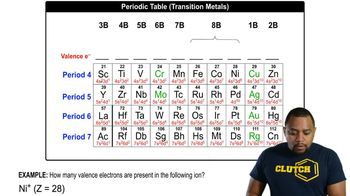
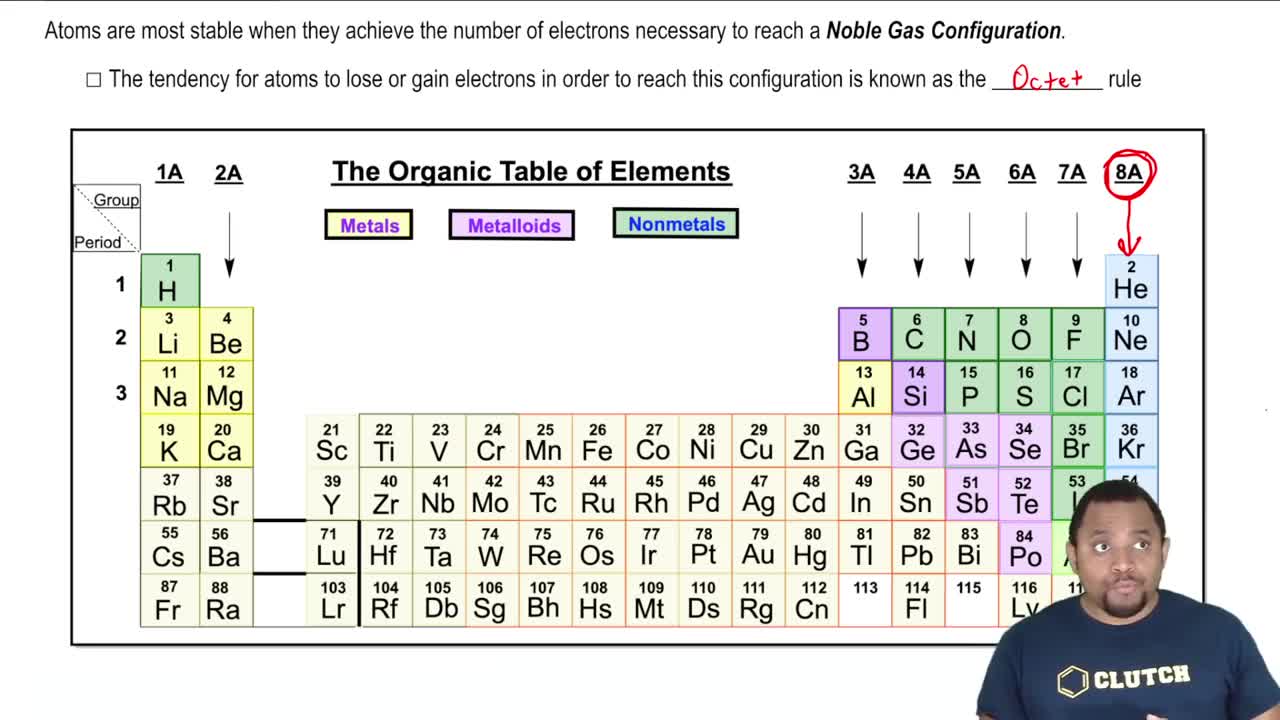
Look at the relative positions of each pair of atoms listed here in the periodic table. How many core electrons does each have? How many valence electrons does each have?
c. nitrogen and phosphorus
d. magnesium and calcium

 Bruice 8th EditionCh. 1 - Remembering General Chemistry: Electronic Structure and Bonding (Part 1)Problem 7
 Verified step by step guidance
 03:40
03:40
 02:24
02:24 07:07
07:07Look at the relative positions of each pair of atoms listed here in the periodic table. How many core electrons does each have? How many valence electrons does each have?
c. nitrogen and phosphorus
d. magnesium and calcium
An atom with a formal charge does not necessarily have more or less electron density than the atoms in the molecule without formal charges. We can see this by examining the potential maps for H2O, H3O+, and HO−.
<IMAGE>
a. Which atom bears the formal negative charge in the hydroxide ion?
b. Which atom has the greater electron density in the hydroxide ion?
An atom with a formal charge does not necessarily have more or less electron density than the atoms in the molecule without formal charges. We can see this by examining the potential maps for H2O, H3O+, and HO−.
<IMAGE>
c. Which atom bears the formal positive charge in the hydronium ion?
d. Which atom has the least electron density in the hydronium ion?
Give each atom the appropriate formal charge:
a.
b.
Look at the relative positions of each pair of atoms listed here in the periodic table. How many core electrons does each have? How many valence electrons does each have?
a. carbon and silicon
b. oxygen and sulfur
How many valence electrons do chlorine, bromine, and iodine have?