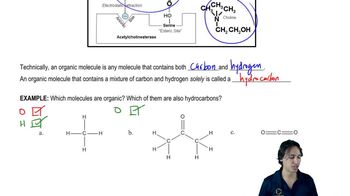
An organic molecule contains both carbon and hydrogen. A molecule with only carbon and hydrogen is called a hydrocarbon.
What is the atomic number of an atom?
The atomic number equals the number of protons in the nucleus.
How is the mass number of an atom calculated?
Mass number = number of protons + number of neutrons.
What are isotopes?
Atoms with the same atomic number but different numbers of neutrons.
What is an atomic orbital?
A region of space within a shell that can hold a pair of electrons with opposite spins.
What are cations and anions?
Cations are positively charged atoms (fewer electrons than protons). Anions are negatively charged atoms (more electrons than protons).
State the Aufbau Principle.
Electrons fill orbitals in order of increasing energy.
State the Pauli Exclusion Principle.
A maximum of two electrons can occupy each orbital, with opposite spins.
State Hund's Rule.
Electrons fill orbitals of equal energy singly before pairing up.
What does the Heisenberg Uncertainty Principle state?
We cannot simultaneously know an electron's exact position and momentum.
What is a wave function in quantum mechanics?
An equation describing the energy state of an electron; its square gives the probability of finding the electron.
What is an atomic orbital shape?
A 3D plot of the wave function showing regions where the electron is likely to be found.
What happens when atomic orbitals overlap constructively?
They form bonding molecular orbitals with shared electron density.
What is the Linear Combination of Atomic Orbitals (LCAO)?
A model using addition and subtraction of atomic orbitals to predict molecular orbital energies.
Define sigma (σ) and pi (π) bonds.
σ bonds form by head-on overlap of orbitals; π bonds form by side-on overlap of p orbitals.
What is the octet rule?
Atoms tend to gain, lose, or share electrons to achieve a noble gas configuration of 8 valence electrons.
How many octet electrons do first-row elements like H, He, and Li prefer?
They prefer to have 2 octet electrons.
What are formal charges?
Formal charge = Group number - (number of valence electrons + 1/2 bonding electrons). It helps determine the most stable Lewis structure.
What is the bondline (skeletal) structure convention?
Carbon atoms are implied at line ends and bends; hydrogens on carbons are implied to fill octets; heteroatoms and hydrogens on them are drawn explicitly.
How do you determine the number of implied hydrogens on a carbon in bondline structures?
Count the bonds to carbon; implied hydrogens = 4 minus the number of bonds.
 Back
Back
 02:08
02:08