Back

Wolff Kishner Reduction definitions

Control buttons has been changed to "navigation" mode.
1/15
  • Wolff Kishner Reduction

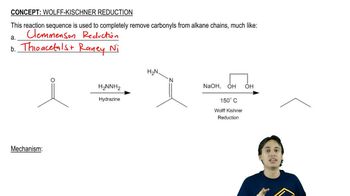
    A method that transforms carbonyl groups into alkanes by using hydrazone intermediates under basic, heated conditions.
  • Hydrazone

    A compound formed by the reaction of hydrazine with a carbonyl, serving as a key intermediate in certain reductions.
  • Hydrazine

    A reagent that reacts with carbonyl compounds to generate hydrazones, facilitating the removal of oxygen atoms.
  • Carbonyl Group

    A functional group characterized by a carbon double-bonded to oxygen, commonly found in aldehydes and ketones.
  • Alkane

    A saturated hydrocarbon produced as the final product when a carbonyl group is fully reduced.
  • Base-Catalyzed Proton Transfer

    A process where a base facilitates the movement of hydrogen atoms, crucial for bond rearrangements in reductions.
  • Nitrogen Gas

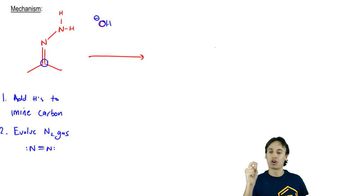
    A diatomic molecule released during the reaction, identified by a strong triple bond between two nitrogen atoms.
  • Strong Base

    A substance like NaOH or KOH that initiates deprotonation steps, driving the reduction mechanism forward.
  • Ethylene Glycol

    A common alcohol solvent used to provide optimal conditions for the reduction without participating in the mechanism.
  • Imine Derivative

    A compound featuring a carbon-nitrogen double bond, formed as an intermediate during hydrazone synthesis.
  • Proton Transfer

    A step involving the movement of a hydrogen ion, essential for converting intermediates during the reduction.
  • Anion

    A negatively charged intermediate formed transiently during the reaction, often stabilized by subsequent protonation.
  • Reagent

    A chemical substance added to cause a transformation, such as hydrazine or a strong base in this reduction.
  • Heat

    An energy input required to drive the reaction to completion, ensuring the evolution of nitrogen gas and alkane formation.
  • Mechanism

    A sequence of steps detailing how reactants are converted to products, involving intermediates and electron movements.