Skip to main content
Organic Chemistry
My Course
Learn
Exam Prep
AI Tutor
Study Guides
Textbook Solutions
Flashcards
Explore
Try the app
My Course
Learn
Exam Prep
AI Tutor
Study Guides
Textbook Solutions
Flashcards
Explore
Try the app
Back
UV-Vis Spectroscopy of Conjugated Alkenes quiz
You can tap to flip the card.
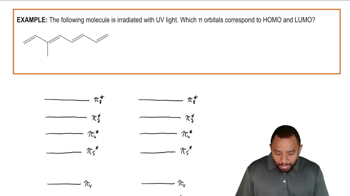
What happens to an electron when UV or visible light energy is applied to a molecule?
You can tap to flip the card.
👆
What happens to an electron when UV or visible light energy is applied to a molecule?
The electron is promoted from a lower energy molecular orbital (HOMO) to a higher energy molecular orbital (LUMO).
Track progress
Control buttons has been changed to "navigation" mode.
1/15
Related flashcards
Related practice
Recommended videos
UV-Vis Spectroscopy of Conjugated Alkenes definitions
UV-Vis Spectroscopy of Conjugated Alkenes
14 Terms
UV-Vis Spectroscopy of Conjugated Alkenes
17. Ultraviolet Spectroscopy
5 problems
Topic
Woodward-Fieser Rules
17. Ultraviolet Spectroscopy
5 problems
Topic
17. Ultraviolet Spectroscopy
4 topics
12 problems
Chapter
1:56
UV-Vis Spectroscopy of Conjugated Alkenes Concept 1
1
views
1:33
UV-Vis Spectroscopy of Conjugated Alkenes Example 1
3
views
3:17
UV-Vis Spectroscopy of Conjugated Alkenes Concept 2
Terms in this set (15)
Hide definitions
What happens to an electron when UV or visible light energy is applied to a molecule?
The electron is promoted from a lower energy molecular orbital (HOMO) to a higher energy molecular orbital (LUMO).
What does HOMO stand for in molecular orbital theory?
HOMO stands for Highest Occupied Molecular Orbital, which is the highest energy orbital containing electrons.
What does LUMO stand for in molecular orbital theory?
LUMO stands for Lowest Unoccupied Molecular Orbital, which is the lowest energy orbital without electrons.
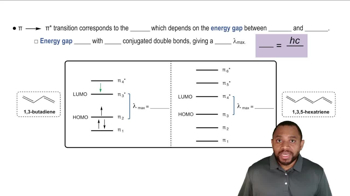
How does UV radiation affect the molecular orbitals in 1,3-butadiene?
UV radiation promotes an electron from the HOMO to the LUMO, changing which orbitals are occupied and unoccupied.
What is lambda max in UV-Vis spectroscopy?
Lambda max is the wavelength at which maximum absorption occurs during electronic transitions.
How does the energy gap between HOMO and LUMO change with increased conjugation?
The energy gap decreases as the number of conjugated double bonds increases.
What is the relationship between energy and wavelength in UV-Vis spectroscopy?
Energy and wavelength are inversely related; as energy decreases, wavelength increases.
What is the lambda max for 1,3-butadiene?
The lambda max for 1,3-butadiene is 217 nanometers.
What is the lambda max for 1,3,5-hexatriene?
The lambda max for 1,3,5-hexatriene is 258 nanometers.
Why does 1,3,5-hexatriene have a higher lambda max than 1,3-butadiene?
Because 1,3,5-hexatriene has more conjugation, which lowers the energy gap and increases the lambda max.
What type of electronic transition is observed in UV-Vis spectroscopy of conjugated alkenes?
A pi to pi* (pi star) electronic transition is observed.
How does increasing conjugation affect the absorption spectrum of a molecule?
Increasing conjugation shifts absorption to longer wavelengths, potentially moving from the UV to the visible spectrum.
What causes visible colors in many plants according to UV-Vis spectroscopy?
Highly conjugated compounds in plants absorb visible light, resulting in observable colors.
What equation relates energy and wavelength in UV-Vis spectroscopy?
Energy equals Planck's constant times the speed of light divided by wavelength (E = h*c/λ).
What happens to lambda max as the energy gap between HOMO and LUMO decreases?
Lambda max increases as the energy gap decreases.
 BackBack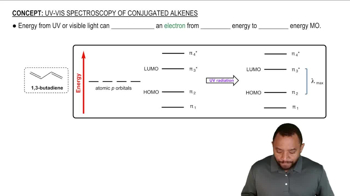
 1:56
1:56