Back

Enantiomers vs. Diastereomers definitions

Control buttons has been changed to "navigation" mode.
1/13
  • Chiral Center

    A carbon atom bonded to four distinct groups, enabling non-superimposable mirror image forms.
  • Achiral Compound

    A molecule that is superimposable on its mirror image, lacking handedness.
  • Atropisomer

    A molecule without chiral centers that is chiral due to restricted rotation around a bond.
  • Enantiomer

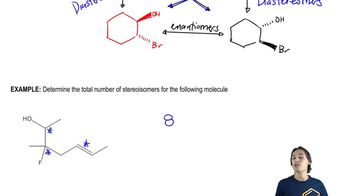
    A stereoisomer that is a non-superimposable mirror image of another molecule.
  • Diastereomer

    A stereoisomer that is not a mirror image of its counterpart, differing at one or more but not all chiral centers.
  • Meso Compound

    A molecule with multiple chiral centers that is achiral due to an internal plane of symmetry.
  • Stereoisomer

    A compound with the same molecular formula and connectivity but differing in spatial arrangement.
  • Mirror Image

    A spatial arrangement that reflects a molecule as if seen in a mirror, used to distinguish enantiomers.
  • 2 to the n Rule

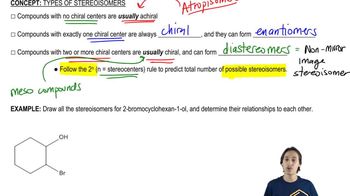
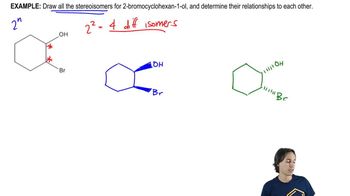
    A formula predicting the maximum number of stereoisomers, where n equals the number of stereocenters.
  • Stereocenter

    An atom, typically carbon, at which the interchange of two groups produces a stereoisomer.
  • Internal Symmetry

    A feature where a molecule can be divided into two identical halves, leading to achirality in some cases.
  • Non-superimposable

    A property where two objects cannot be placed on top of each other to give the same structure.
  • Handedness

    A characteristic of molecules that exist in forms which are mirror images but not superimposable.