Skip to main content
Organic Chemistry
My Course
Learn
Exam Prep
AI Tutor
Study Guides
Textbook Solutions
Flashcards
Explore
Try the app
My Course
Learn
Exam Prep
AI Tutor
Study Guides
Textbook Solutions
Flashcards
Explore
Try the app
Back
Triacylglycerol Reactions: Hydrolysis definitions
You can tap to flip the card.
Saponification
You can tap to flip the card.
👆
Saponification
Base-catalyzed process breaking ester bonds in triglycerides to yield glycerol and fatty acid salts, key in soap production.
Track progress
Control buttons has been changed to "navigation" mode.
1/15
Related flashcards
Related practice
Recommended videos
Triacylglycerol Reactions: Hydrolysis quiz
Triacylglycerol Reactions: Hydrolysis
10 Terms
Triacylglycerol Reactions: Hydrolysis
32. Lipids
5 problems
Topic
Phosphoglycerides
32. Lipids
5 problems
Topic
32. Lipids - Part 1 of 3
4 topics
12 problems
Chapter
32. Lipids - Part 2 of 3
4 topics
12 problems
Chapter
32. Lipids - Part 3 of 3
2 topics
6 problems
Chapter
Guided course
1:58
Triacylglycerol Reactions: Hydrolysis Concept 1
1
views
Guided course
3:47
Triacylglycerol Reactions: Hydrolysis Concept 2
Guided course
1:48
Triacylglycerol Reactions: Hydrolysis Example 2
Terms in this set (15)
Hide definitions
Saponification
Base-catalyzed process breaking ester bonds in triglycerides to yield glycerol and fatty acid salts, key in soap production.
Triglyceride
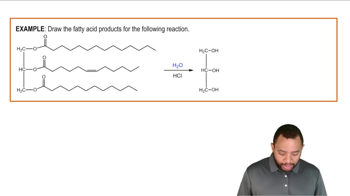
Molecule with three fatty acid chains esterified to a glycerol backbone, main substrate in hydrolysis reactions.
Ester Linkage
Bond connecting fatty acid chains to glycerol, targeted and cleaved during hydrolysis reactions.
Carboxylate Anion
Negatively charged species formed from fatty acids during base-catalyzed hydrolysis, paired with metal cations.
Glycerol
Three-carbon alcohol produced as a byproduct in both acid and base hydrolysis of triglycerides.
Fatty Acid
Long hydrocarbon chain with a carboxylic acid group, released from triglycerides during hydrolysis.
Sodium Hydroxide
Strong base used in saponification, leading to the formation of solid soap from triglycerides.
Potassium Hydroxide
Strong base used in saponification, resulting in the production of liquid soap.
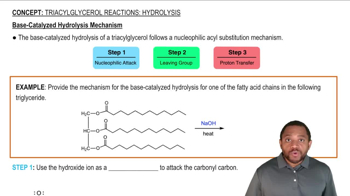
Nucleophilic Acyl Substitution
Mechanism involving nucleophilic attack, leaving group loss, and proton transfer, central to hydrolysis of esters.
Hydronium Ion
Protonated water molecule acting as an acid catalyst in acid-catalyzed hydrolysis of triglycerides.
Carboxylic Acid
Product formed from fatty acids during acid-catalyzed hydrolysis, featuring a carbonyl and hydroxyl group.
Alkoxide Ion
Leaving group generated during base-catalyzed hydrolysis, later protonated to form part of glycerol.
Lipase
Digestive enzyme catalyzing hydrolysis of triglycerides under mild conditions, yielding glycerol and fatty acids.
Proton Transfer
Step involving movement of a hydrogen ion, crucial in both acid and base hydrolysis mechanisms.
Leaving Group
Fragment that departs during nucleophilic acyl substitution, facilitating bond cleavage in hydrolysis.
 BackBack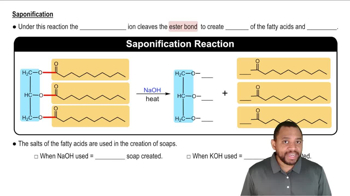
 1:58
1:58