Skip to main content
Organic Chemistry
My Course
Learn
Exam Prep
AI Tutor
Study Guides
Textbook Solutions
Flashcards
Explore
Try the app
My Course
Learn
Exam Prep
AI Tutor
Study Guides
Textbook Solutions
Flashcards
Explore
Try the app
Back
Triacylglycerol Reactions: Hydrogenation definitions
You can tap to flip the card.
Triacylglycerol
You can tap to flip the card.
👆
Triacylglycerol
A molecule with three fatty acid chains attached to a glycerol backbone, commonly found in fats and oils.
Track progress
Control buttons has been changed to "navigation" mode.
1/14
Related flashcards
Related practice
Recommended videos
Triacylglycerol Reactions: Hydrogenation quiz
Triacylglycerol Reactions: Hydrogenation
15 Terms
Triacylglycerol Reactions: Hydrogenation
32. Lipids
5 problems
Topic
Triacylglycerol Reactions: Hydrolysis
32. Lipids
5 problems
Topic
32. Lipids - Part 1 of 3
4 topics
12 problems
Chapter
32. Lipids - Part 2 of 3
4 topics
12 problems
Chapter
32. Lipids - Part 3 of 3
2 topics
6 problems
Chapter
Guided course
0:57
Triacylglycerol Reactions: Hydrogenation Example 1
4
views
Guided course
3:55
Triacylglycerol Reactions: Hydrogenation Concept 1
1
views
Terms in this set (14)
Hide definitions
Triacylglycerol
A molecule with three fatty acid chains attached to a glycerol backbone, commonly found in fats and oils.
Hydrogenation
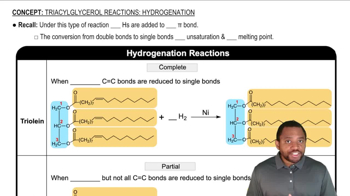
A process where hydrogen atoms are added to unsaturated bonds, reducing double bonds to single bonds in fatty acids.
Unsaturation
The presence of carbon-carbon double bonds within fatty acid chains, influencing melting point and reactivity.
Melting Point
The temperature at which a fat transitions from solid to liquid, increased by reducing unsaturation.
Complete Hydrogenation
A reaction where all double bonds in fatty acid chains are converted to single bonds, yielding fully saturated fats.
Partial Hydrogenation
A reaction where only some double bonds are reduced, leaving at least one double bond intact in the fatty acid chains.
Nickel Catalyst
A metal used to accelerate the addition of hydrogen to double bonds during the hydrogenation process.
Pi Bond
A type of covalent bond formed from the sideways overlap of p orbitals, present in carbon-carbon double bonds.
Cis Configuration
A geometric arrangement where substituents on a double bond are on the same side, common in natural unsaturated fats.
Trans Configuration
A geometric arrangement where substituents on a double bond are on opposite sides, often formed during partial hydrogenation.
Trans Fats
Fatty acids containing at least one trans double bond, associated with negative health effects and often produced industrially.
Saturation
A state where all carbon atoms in fatty acid chains are connected by single bonds, resulting from complete hydrogenation.
Margarine
A spreadable fat product created by partial hydrogenation of oils, with consistency determined by remaining double bonds.
Isomerization
A process where the arrangement of atoms around a double bond changes, such as from cis to trans during hydrogenation.
 BackBack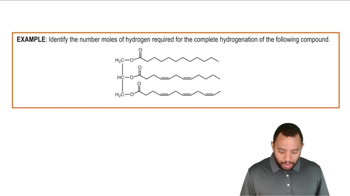
 0:57
0:57