Back

Thermal Electrocyclic Reactions quiz

Control buttons has been changed to "navigation" mode.
1/15
  • What is a thermal electrocyclic reaction?

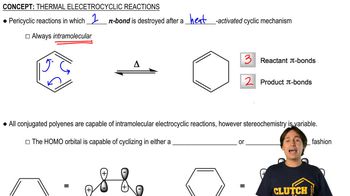
    A thermal electrocyclic reaction is a heat-activated pericyclic reaction where one pi bond is altered, typically forming a new ring through an intramolecular mechanism.
  • How many pi bonds are lost in a typical electrocyclic reaction?

    One pi bond is lost or changed from reactants to products in a typical electrocyclic reaction.
  • Are thermal electrocyclic reactions intermolecular or intramolecular?

    Thermal electrocyclic reactions are always intramolecular, involving a single molecule reacting with itself.
  • What type of bond is formed during a thermal electrocyclic reaction?

    A new sigma bond is formed during a thermal electrocyclic reaction, replacing a pi bond.
  • What is the mechanism of electron movement in thermal electrocyclic reactions?

    The electron movement is concerted and cyclic, meaning all electrons move simultaneously to form the new ring.
  • Can all conjugated polyenes undergo thermal electrocyclic reactions?

    Yes, all conjugated polyenes, regardless of the number of pi bonds, can undergo these reactions.
  • What determines the stereochemistry of the product in a thermal electrocyclic reaction?

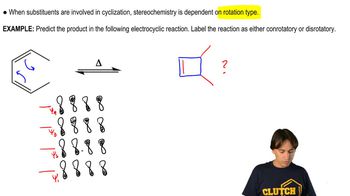
    The stereochemistry is determined by the Highest Occupied Molecular Orbital (HOMO) and its mode of cyclization.
  • What are the two possible modes of orbital rotation in electrocyclic reactions?

    The two modes are conrotatory (same direction) and disrotatory (opposite directions) rotation.
  • What does conrotatory motion mean in the context of electrocyclic reactions?

    Conrotatory motion means both terminal orbitals rotate in the same direction to overlap like phases.
  • What does disrotatory motion mean in the context of electrocyclic reactions?

    Disrotatory motion means the terminal orbitals rotate in opposite directions to achieve the necessary overlap.
  • How does the type of orbital rotation affect the product of an electrocyclic reaction?

    The type of rotation (conrotatory or disrotatory) determines the stereochemistry and orientation of substituents on the new ring.
  • Why is understanding molecular orbital rotation important in electrocyclic reactions?

    Understanding orbital rotation is crucial for predicting the stereochemistry of the products formed.
  • What is the focus when solving electrocyclic reaction problems?

    The focus is on predicting the stereochemistry of the product, not just ring formation.
  • How can you predict the orientation of substituents after an electrocyclic reaction?

    You must know the type of orbital rotation (conrotatory or disrotatory) to predict substituent orientation.
  • What happens to the number of pi bonds after a thermal electrocyclic reaction?

    The number of pi bonds decreases by one after the reaction, as a new sigma bond is formed.