Organic Chemistry
My Course
Learn
Exam Prep
AI Tutor
Study Guides
Textbook Solutions
Flashcards
Explore
Try the app
My Course
Learn
Exam Prep
AI Tutor
Study Guides
Textbook Solutions
Flashcards
Explore
Try the app
Back
The Citric Acid Cycle definitions
You can tap to flip the card.
Oxaloacetate
You can tap to flip the card.
👆
Oxaloacetate
A four-carbon molecule regenerated at the end of the cycle, enabling continuous processing of acetyl groups.
Track progress
Control buttons has been changed to "navigation" mode.
1/15
Related flashcards
Recommended videos
The Citric Acid Cycle quiz
The Citric Acid Cycle
10 Terms
1:33
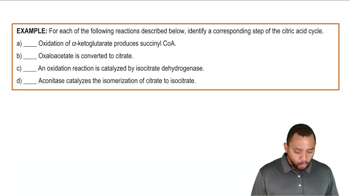
The Citric Acid Cycle Example 2
3
views
1:01
The Citric Acid Cycle Concept 9
3
views
1:08
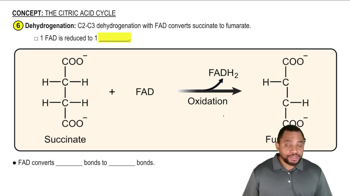
The Citric Acid Cycle Concept 6
3
views
Terms in this set (15)
Hide definitions
Oxaloacetate
A four-carbon molecule regenerated at the end of the cycle, enabling continuous processing of acetyl groups.
Acetyl CoA
A two-carbon molecule that enters the cycle, combining with oxaloacetate to initiate citrate formation.
Citrate
A six-carbon intermediate formed from acetyl CoA and oxaloacetate, marking the start of the cycle.
Isocitrate
A structural isomer of citrate, featuring a secondary alcohol, primed for oxidation and decarboxylation.
Alpha Ketoglutarate
A five-carbon intermediate produced after isocitrate oxidation and decarboxylation, precursor to succinyl CoA.
Succinyl CoA
A four-carbon thioester intermediate, formed after a second decarboxylation, ready for hydrolysis to succinate.
Succinate
A four-carbon dicarboxylate generated from succinyl CoA, later oxidized to fumarate.
Fumarate
A planar, four-carbon molecule produced by succinate dehydrogenation, precursor to malate.
Malate
A four-carbon alcohol formed by hydration of fumarate, oxidized in the final step to regenerate oxaloacetate.
NADH
A high-energy electron carrier generated during oxidation steps, crucial for ATP production in the electron transport chain.
FADH2
A reduced electron carrier formed during succinate oxidation, contributing electrons to the respiratory chain.
ATP
A universal energy currency synthesized during the cycle via substrate-level phosphorylation from succinyl CoA hydrolysis.
Decarboxylation
A reaction type in the cycle where a carbon atom is released as carbon dioxide, reducing the carbon count of intermediates.
Hydrolysis
A reaction involving water to cleave chemical bonds, notably converting succinyl CoA to succinate and generating ATP.
Dehydrogenation
A process where hydrogen atoms are removed from a substrate, often coupled with reduction of NAD+ or FAD.