What is the first step required to functionalize an unreactive alkane in organic synthesis?
The first step is alkane halogenation, typically using a radical reaction like Br2 over heat to add a halogen as a functional group.
What type of reaction is used to add a halogen to an alkane?
A radical reaction, such as using Br2 with heat, is used to halogenate an alkane.
What is an organometal, and why is it important in synthesis?
An organometal is a molecule containing a carbon-metal bond, and it is important because it acts as a strong nucleophile for forming new carbon-carbon bonds.
Which two organometals are commonly used for chain extension in organic synthesis?
Sodium alkynides and Grignard reagents are commonly used organometals for chain extension.
What is the main electrophile used with organometals to form new carbon-carbon bonds?
Alkyl halides are the main electrophiles used with organometals to form new carbon-carbon bonds.
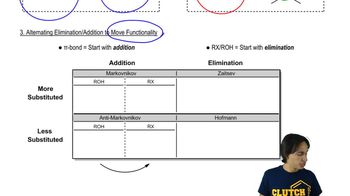
How can you move a functional group from one position to another within a molecule?
By performing alternating elimination and addition reactions, you can move a functional group to a different position in the molecule.
What type of elimination moves a group toward a more substituted (central) position, and what base is typically used?
A Zaitsev elimination moves a group toward a more substituted position, using a small, strong base like NaNH2 or NaH.
Which bases are considered bulky and favor Hoffman elimination?
Bulky bases like LDA, t-Butoxide, and LiTMP favor Hoffman elimination, which moves the group toward a less substituted position.
What is the difference between Markovnikov and anti-Markovnikov addition?
Markovnikov addition adds a group to the more substituted carbon, while anti-Markovnikov addition adds to the less substituted carbon.
Which reagents are used for Markovnikov addition of alcohol to a double bond?
Acid-catalyzed hydration (H2SO4/H2O) and oxymercuration (Hg(OAc)2/H2O, then NaBH4/OH-) are used for Markovnikov addition of alcohol.
What reagent is used for Markovnikov addition of a halogen to a double bond?
HX (hydrogen halide) is used for Markovnikov addition of a halogen to a double bond.
Which reaction and reagents are used for anti-Markovnikov addition of alcohol?
Hydroboration-oxidation (BH3/THF, then H2O2/NaOH) is used for anti-Markovnikov addition of alcohol.
How do you achieve anti-Markovnikov addition of a halogen to a double bond?
By using a radical reaction with HX and peroxides, you achieve anti-Markovnikov addition of a halogen.
When starting with a double bond and needing to move a functional group, which reaction type should you perform first?
You should perform an addition reaction first if you start with a double bond.
If you start with an alkyl halide or alcohol and want to move a functional group, what is your first step?
You should perform an elimination reaction first if you start with an alkyl halide or alcohol.
 Back
Back
 16:21
16:21