Back

Synthesis of Amino Acids: Strecker Synthesis definitions

Control buttons has been changed to "navigation" mode.
1/15
  • Strecker Synthesis

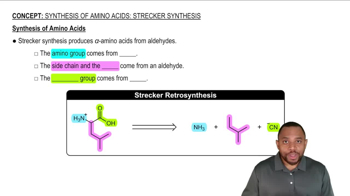
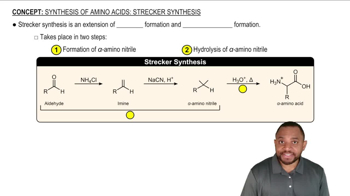
    A two-step process converting aldehydes into alpha amino acids via alpha aminonitrile and acid hydrolysis.
  • Alpha Amino Acid

    A molecule featuring an amino group, carboxylic acid, and side chain all bonded to the same central carbon.
  • Aldehyde

    An organic compound with a carbonyl group bonded to at least one hydrogen, serving as the starting material.
  • Imine

    A functional group where a carbon is double-bonded to a nitrogen, formed as an intermediate in the synthesis.
  • Alpha Aminonitrile

    An intermediate containing both an amino group and a nitrile group attached to the same carbon.
  • Acid Hydrolysis

    A reaction using acid and water to convert a nitrile group into a carboxylic acid.
  • Nucleophilic Addition

    A mechanism where a nucleophile attacks an electrophilic carbon, central to forming key intermediates.
  • Protonation

    The addition of a proton to a molecule, often increasing its reactivity in the mechanism.
  • Tetrahedral Intermediate

    A transient structure formed when a nucleophile adds to a carbonyl carbon, resulting in four substituents.
  • Cyanide Ion

    A nucleophile that adds to the imine carbon, introducing the nitrile group in the process.
  • Carboxylic Acid

    A functional group with a carbon double-bonded to oxygen and single-bonded to a hydroxyl, formed after hydrolysis.
  • Amino Group

    A functional group consisting of a nitrogen atom bonded to hydrogens, derived from ammonia in the synthesis.
  • Side Chain

    A variable group attached to the alpha carbon, originating from the starting aldehyde.
  • Retrosynthetic Analysis

    A strategy of thinking backwards from the product to identify precursor molecules and steps.
  • Leaving Group

    An atom or group that departs with a pair of electrons during a reaction, such as water in imine formation.