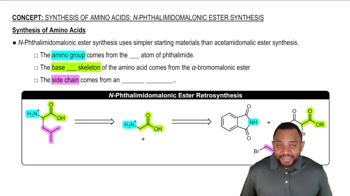
What two synthesis methods are combined in the N-phthalimidomalonic ester synthesis?
The N-phthalimidomalonic ester synthesis combines Gabriel synthesis and malonic ester synthesis.
What is the first step in the N-phthalimidomalonic ester synthesis?
The first step is an SN2 reaction where potassium ethylamide displaces bromine on an alpha-bromomalonic ester.
What product is formed after the SN2 reaction in step 1?
The product formed is N-methylamidomalonic ester.
What happens during the enolization step of the synthesis?
A strong base deprotonates the alpha carbon of the N-methylamidomalonic ester, forming an enolate ion.
How is the side chain introduced in the synthesis?
The enolate ion attacks an alkyl halide in an SN2 reaction, alkylating the alpha carbon.
What is the purpose of acid hydrolysis in step 4a?
Acid hydrolysis converts the esters into carboxylic acids.
What occurs during the decarboxylation step (4b)?
Decarboxylation causes the loss of one carboxylic acid group as CO2, yielding the amino acid.
From which molecule does the amino group in the final amino acid originate?
The amino group comes from the nitrogen atom of the phthalimide molecule.
What provides the base carbon skeleton of the amino acid?
The base carbon skeleton comes from the alpha-bromomalonic ester.
What is the source of the side chain in the synthesized amino acid?
The side chain is introduced from the alkyl halide used in the alkylation step.
What type of reaction mechanism is used to displace bromine in step 1?
An SN2 nucleophilic substitution mechanism is used.
What role does potassium ethylamide play in the synthesis?
Potassium ethylamide acts as a nucleophile, displacing bromine from the alpha-bromomalonic ester.
What is released during the decarboxylation step?
CO2 (carbon dioxide) is released during decarboxylation.
What functional group transformation occurs during acid hydrolysis?
Esters are transformed into carboxylic acids.
Why is the N-phthalimidomalonic ester synthesis important in organic chemistry?
It demonstrates nucleophilic substitution, enolate ion chemistry, and decarboxylation, which are key concepts in amino acid synthesis and functional group transformations.