Back

Suzuki Reaction quiz

Control buttons has been changed to "navigation" mode.
1/15
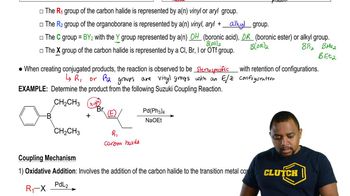
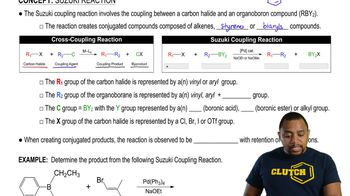
  • What two types of compounds are coupled in the Suzuki reaction?

    A carbon halide and an organoboron compound are coupled in the Suzuki reaction.
  • What is the typical catalyst used in the Suzuki reaction?

    A transition metal complex, usually palladium, is used as the catalyst.
  • Name three types of products that can be formed by the Suzuki reaction.

    The Suzuki reaction can form alkenes, styrenes, or biaryls.
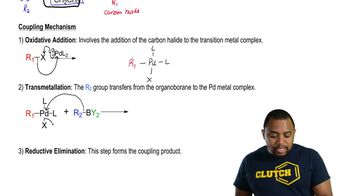
  • What are the three main steps in the catalytic cycle of the Suzuki reaction?

    The three main steps are oxidative addition, transmetalation, and reductive elimination.
  • What happens during the oxidative addition step of the Suzuki reaction?

    The carbon halide adds to the palladium complex, bonding palladium to both the halide and the organic group.
  • What occurs during the transmetalation step in the Suzuki reaction?

    The R2 group from the organoboron compound transfers to the palladium, while the halide moves to the boron.
  • What is the purpose of the reductive elimination step in the Suzuki reaction?

    Reductive elimination connects R1 and R2 to form the final product and regenerates the palladium catalyst.
  • What are common leaving groups (X) in the carbon halide for the Suzuki reaction?

    Common leaving groups are chlorine, bromine, iodine, or triflate.
  • What forms of organoboron compounds can be used in the Suzuki reaction?

    Boronic acids (BOH2), boronic esters (B(OR)2), or boron compounds with alkyl groups (BR2) can be used.
  • What is the role of ligands (L) in the Suzuki reaction catalyst?

    Ligands stabilize the transition metal catalyst, and there are usually 2 or 4 ligands.
  • What byproducts are formed in the Suzuki reaction?

    The byproducts are the leaving group X and the BY2 group from the organoboron compound.
  • Why is the regeneration of the palladium catalyst important in the Suzuki reaction?

    Regeneration allows the catalytic cycle to continue, making the reaction efficient and repeatable.
  • What is the main driving force for the Suzuki coupling reaction?

    The main driving force is the formation of a more conjugated product and maintaining the electron count around palladium.
  • How does the Suzuki reaction help follow the 18 or 16 electron rule?

    The reaction cycle adjusts the electron count around palladium, which seeks to maintain the 18 or 16 electron configuration.
  • What happens to the R1 and R2 groups in the Suzuki reaction?

    R1 from the carbon halide and R2 from the organoboron compound combine to form the coupling product.