Back

Structures of the Citric Acid Cycle quiz

Control buttons has been changed to "navigation" mode.
1/15
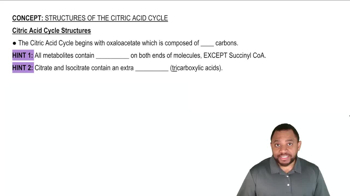
  • What is the starting molecule of the Citric Acid Cycle and how many carbons does it contain?

    The starting molecule is oxaloacetate, which contains 4 carbons.
  • Which metabolite in the Citric Acid Cycle does NOT have carboxylate groups on both ends?

    Succinyl CoA is the only metabolite without carboxylate groups on both ends.
  • What structural feature distinguishes citrate and isocitrate from other cycle intermediates?

    Citrate and isocitrate are tricarboxylic acids, meaning they have three carboxyl groups.
  • How is citrate formed from oxaloacetate in the Citric Acid Cycle?

    Citrate is formed by adding an acetate group to carbon 2 of oxaloacetate, converting a ketone to an alcohol.
  • What is the relationship between citrate and isocitrate?

    Citrate and isocitrate are isomers, specifically differing in the position of the hydroxyl group between carbons 2 and 3.
  • What type of alcohol is present in citrate and how does it change in isocitrate?

    Citrate contains a tertiary alcohol, which becomes a secondary alcohol in isocitrate.
  • How is alpha-ketoglutarate structurally characterized?

    Alpha-ketoglutarate has a ketone group on the alpha carbon next to a carboxyl group.
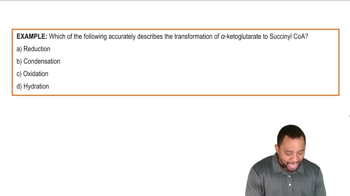
  • What happens to the number of carbons as the cycle progresses from isocitrate to succinyl CoA?

    A carboxyl group is lost, reducing the number of carbons to four in succinyl CoA.
  • Where is the CoA group attached in succinyl CoA?

    The CoA group is attached to the fourth carbon of succinyl CoA.
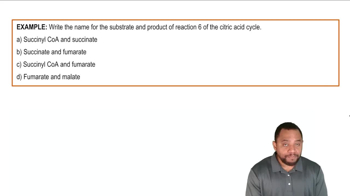
  • What is the main structural change when succinyl CoA is converted to succinate?

    The CoA group is removed, restoring the dicarboxylic acid structure.
  • What is the key structural feature of fumarate?

    Fumarate is a flat molecule due to the presence of a trans double bond (alkene) between two carbons.
  • What reaction converts fumarate to malate, and what is added?

    Fumarate is converted to malate by a hydration reaction, where water (H and OH) is added.
  • How is oxaloacetate regenerated from malate?

    Malate is oxidized to form oxaloacetate, converting an alcohol group into a ketone.
  • What mnemonic can help remember the order of Citric Acid Cycle intermediates?

    The mnemonic 'Oxford City, ice crates, kegs, and such contain succulent foamy milk' helps recall the sequence.
  • Why is it important to remember the structures and sequence of Citric Acid Cycle intermediates?

    Understanding these structures and their transformations is crucial for grasping metabolic pathways and energy production.