Back

Skeletal Structure definitions

Control buttons has been changed to "navigation" mode.
1/14
  • Bond Line Method

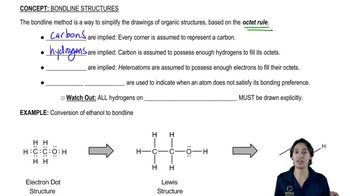
    A drawing style in organic chemistry where carbons and most hydrogens are implied, streamlining molecular representations.
  • Octet Rule

    A guideline stating atoms tend to have eight electrons in their valence shell, influencing implied atoms in structures.
  • Implied Carbon

    A carbon atom not explicitly shown, but assumed at each vertex or line end in a zigzag molecular diagram.
  • Implied Hydrogen

    A hydrogen atom not drawn, but assumed to be bonded to carbon to satisfy its octet in simplified structures.
  • Heteroatom

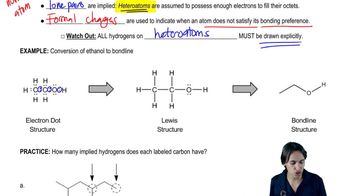
    Any atom in an organic molecule that is not carbon, such as nitrogen, oxygen, or fluorine.
  • Lone Pair

    A pair of valence electrons on an atom, not involved in bonding, often omitted in simplified drawings unless needed.
  • Formal Charge

    A calculated value indicating if an atom has more or fewer electrons than its typical bonding preference.
  • Bonding Preference

    The typical number of bonds an atom forms to satisfy its valence shell, deviations often marked by formal charges.
  • Zigzag Pattern

    A visual representation in bond line drawings where each angle or end signifies a carbon atom.
  • Explicit Hydrogen

    A hydrogen atom shown in a structure, required when attached to heteroatoms to avoid ambiguity.
  • Organic Molecule

    A compound primarily composed of carbon atoms, often depicted using simplified bond line structures.
  • Repetitive Drawing

    The unnecessary depiction of atoms or electrons multiple times, minimized by the bond line method.
  • Noncarbon Atom

    An atom other than carbon within an organic structure, typically a heteroatom like oxygen or nitrogen.
  • Valence Electron

    An electron in the outermost shell of an atom, crucial for bonding and determining implied atoms in structures.