Back

Silyl Ether Protecting Groups definitions

Control buttons has been changed to "navigation" mode.
1/15
  • Silyl Ether

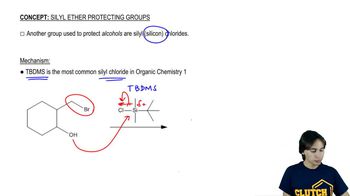
    A silicon-containing group used to temporarily mask alcohols, preventing unwanted reactions during multi-step syntheses.
  • Protecting Group

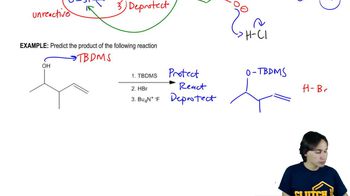
    A chemical modification that temporarily blocks a functional group, allowing selective reactions elsewhere in the molecule.
  • TBDMS

    The most common silyl chloride reagent for forming silyl ethers, notable for its bulky structure and effectiveness in alcohol protection.
  • Alcohol

    A functional group highly reactive with many reagents, often requiring protection to avoid side reactions in synthesis.
  • Deprotection

    The process of removing a protecting group, restoring the original functional group for further chemical manipulation.
  • Silicon

    An element used in place of oxygen in silyl ethers, enabling selective protection of alcohols due to its bonding properties.
  • Chlorine Ion

    A leaving group generated during silyl ether formation, which also acts as a base to deprotonate the protected alcohol.
  • Fluorine Atom

    A nucleophile used in deprotection, attacking silicon to cleave the silyl ether and regenerate the alcohol.
  • Alkyl Halide

    A functional group that can undergo reactions such as substitution or elimination, often present alongside alcohols in synthesis.
  • Strong Base

    A reagent capable of deprotonating alcohols or promoting elimination reactions, necessitating alcohol protection.
  • Nucleophile

    A species that donates an electron pair to form a new bond, potentially reacting with unprotected alcohols.
  • Mechanism

    A stepwise sequence of events showing how reactants are converted to products, crucial for understanding protection and deprotection.
  • Functional Group

    A specific group of atoms within molecules responsible for characteristic reactions, often targeted or protected in synthesis.
  • Leaving Group

    An atom or group that departs with a pair of electrons during a chemical reaction, facilitating bond formation or cleavage.
  • Partial Positive Charge

    An electron-deficient site, such as on silicon in silyl chlorides, making it susceptible to nucleophilic attack.