Back

Sigmatropic Rearrangement quiz

Control buttons has been changed to "navigation" mode.
1/15
  • What is a sigmatropic shift in organic chemistry?

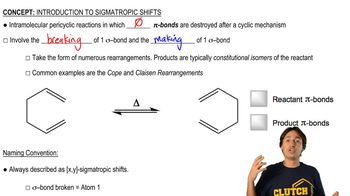
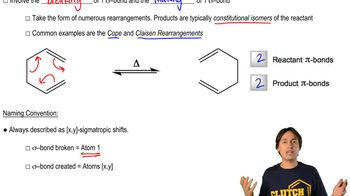
    A sigmatropic shift is an intramolecular pericyclic reaction where a sigma bond is broken and a new sigma bond is formed, without changing the number of pi bonds.
  • What type of isomers are typically formed as products of sigmatropic shifts?

    Sigmatropic shifts usually produce constitutional isomers of the reactant.
  • Which two well-known reactions are common examples of sigmatropic shifts?

    The Cope rearrangement and the Claisen rearrangement are common examples of sigmatropic shifts.
  • Are sigmatropic shifts typically heat-activated or light-activated?

    Sigmatropic shifts are typically heat-activated reactions.
  • What happens to the number of pi bonds during a sigmatropic shift?

    The number of pi bonds remains unchanged during a sigmatropic shift.
  • What is the key bond change that occurs in a sigmatropic shift?

    One sigma bond is broken and a new sigma bond is formed in a cyclic, concerted mechanism.
  • How are sigmatropic shifts named using the 'x, y' nomenclature?

    They are named by identifying the positions (x and y) where the new sigma bond forms relative to the original bond-breaking position.
  • In sigmatropic shift nomenclature, what does the number '1' represent?

    The number '1' represents the atom where the sigma bond is broken.
  • What is the significance of the numbers x and y in the nomenclature of sigmatropic shifts?

    The numbers x and y indicate the positions along the chain where the new sigma bond is formed, counted from the bond-breaking site.
  • Why is understanding the mechanism of sigmatropic shifts more important than memorizing their names?

    Because the mechanism helps you identify and name any sigmatropic shift, rather than relying on memorized names for specific examples.
  • What type of reaction mechanism do sigmatropic shifts follow?

    Sigmatropic shifts follow a concerted, cyclic pericyclic reaction mechanism.
  • If a sigma bond is broken between two atoms in the middle of a chain, how are those atoms labeled in the nomenclature?

    Both atoms involved in the broken bond are labeled as '1' in the nomenclature.
  • How do you determine the x and y positions for naming a sigmatropic shift?

    You count the number of atoms from the bond-breaking site to the atoms where the new sigma bond forms on each chain.
  • What is a 3,3 sigmatropic shift?

    A 3,3 sigmatropic shift is when the new sigma bond forms between the third atom from each side of the original bond-breaking site.
  • What is a quick way to identify a sigmatropic shift in a reaction?

    Check if the product is a constitutional isomer of the reactant with the same number of pi bonds but a different sigma bond arrangement.