Back

Ring Strain definitions

Control buttons has been changed to "navigation" mode.
1/13
  • Heat of Combustion

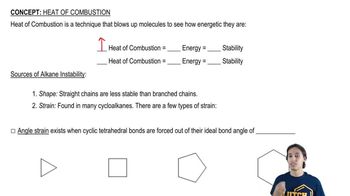
    Analytical measurement indicating molecular energy; higher values reflect greater instability and lower molecular stability.
  • Angle Strain

    Destabilization in rings caused by bond angles deviating from the ideal tetrahedral value of 109.5 degrees.
  • Torsional Strain

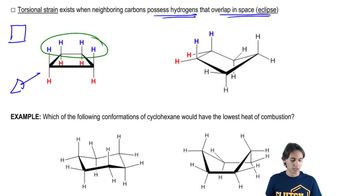
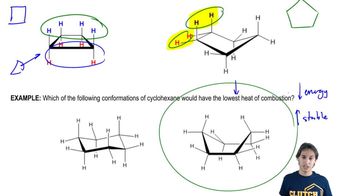
    Instability resulting from eclipsed bonds where adjacent hydrogens overlap in space, increasing molecular energy.
  • Cycloalkane

    Saturated ring structure where strain arises from non-ideal bond angles and eclipsed hydrogens.
  • Cyclopentane

    Five-membered ring with bond angles near 108 degrees, exhibiting minimal angle strain but some torsional strain.
  • Cyclohexane

    Six-membered ring noted for exceptional stability among cycloalkanes, despite bond angles of 120 degrees.
  • Cyclobutane

    Four-membered ring with significant angle and torsional strain due to 90-degree bond angles and eclipsed hydrogens.
  • Straight Chain

    Unbranched alkane structure with higher energy and lower stability compared to its branched counterpart.
  • Branched Chain

    Alkane structure with side groups, resulting in lower energy and greater stability than unbranched forms.
  • Bond Angle

    Geometric measurement between two bonds on the same atom; deviations from 109.5 degrees cause ring strain.
  • Eclipsed Conformation

    Spatial arrangement where atoms or groups on adjacent carbons align, leading to increased torsional strain.
  • Stability

    Relative resistance to energy release; higher values correspond to lower heat of combustion and less strain.
  • Strain

    General term for destabilizing effects in molecules, including angle and torsional types, raising molecular energy.