Skip to main content
Organic Chemistry
My Course
Learn
Exam Prep
AI Tutor
Study Guides
Textbook Solutions
Flashcards
Explore
Try the app
My Course
Learn
Exam Prep
AI Tutor
Study Guides
Textbook Solutions
Flashcards
Explore
Try the app
Back
Reactions of Pyrrole, Furan, and Thiophene quiz
You can tap to flip the card.
What type of reaction do pyrrole, furan, and thiophene undergo similarly to benzene?
You can tap to flip the card.
👆
What type of reaction do pyrrole, furan, and thiophene undergo similarly to benzene?
They undergo electrophilic aromatic substitution (EAS) reactions.
Track progress
Control buttons has been changed to "navigation" mode.
1/15
Related flashcards
Related practice
Recommended videos
Reactions of Pyrrole, Furan, and Thiophene definitions
Reactions of Pyrrole, Furan, and Thiophene
15 Terms
Reactions of Pyrrole, Furan, and Thiophene
27. Heterocycles
5 problems
Topic
Directing Effects in Substituted Pyrroles, Furans, and Thiophenes
27. Heterocycles
5 problems
Topic
27. Heterocycles - Part 1 of 2
4 topics
12 problems
Chapter
27. Heterocycles - Part 2 of 2
4 topics
12 problems
Chapter
3:45
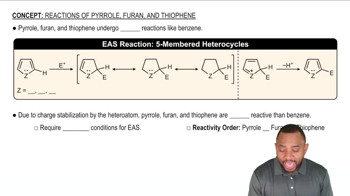
Reactions of Pyrrole, Furan, and Thiophene Concept 2
2
views
1:31
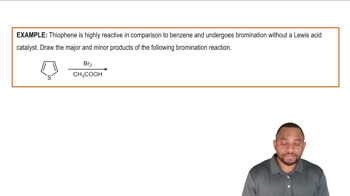
Reactions of Pyrrole, Furan, and Thiophene Example 2
3
views
2:36
Reactions of Pyrrole, Furan, and Thiophene Concept 1
2
views
Terms in this set (15)
Hide definitions
What type of reaction do pyrrole, furan, and thiophene undergo similarly to benzene?
They undergo electrophilic aromatic substitution (EAS) reactions.
Which atoms serve as the heteroatoms in pyrrole, furan, and thiophene?
Pyrrole contains nitrogen, furan contains oxygen, and thiophene contains sulfur.
Why do pyrrole, furan, and thiophene undergo EAS more readily than benzene?
Their heteroatoms stabilize the intermediate, making them more reactive than benzene.
At which carbon does EAS preferentially occur in pyrrole, furan, and thiophene?
EAS preferentially occurs at carbon 2 (the alpha position) in these compounds.
What is the role of the pi bond in the EAS reaction of these heterocycles?
The pi bond attacks the electrophile, forming a new bond and generating a carbocation intermediate.
How is aromaticity restored after the electrophile adds to the ring?
A hydrogen is lost from the carbon where the electrophile added, restoring aromaticity.
What is the order of reactivity for EAS among pyrrole, furan, and thiophene?
Pyrrole is more reactive than furan, which is more reactive than thiophene.
Why are milder conditions required for EAS in pyrrole, furan, and thiophene compared to benzene?
Their increased reactivity due to heteroatom stabilization allows EAS to occur under milder conditions.
What is the major product of EAS in these heterocycles: substitution at carbon 2 or carbon 3?
The major product results from substitution at carbon 2.
What is the minor product of EAS in pyrrole, furan, and thiophene?
The minor product results from substitution at carbon 3.
How does resonance stabilization differ between substitution at carbon 2 and carbon 3?
Substitution at carbon 2 allows more resonance structures that better stabilize the positive charge.
What happens to the heteroatom during resonance after electrophile addition?
The heteroatom can become positively charged in one of the resonance forms.
Why is substitution at carbon 2 favored over carbon 3 in EAS?
Because resonance structures for carbon 2 substitution place the positive charge on less electronegative atoms, stabilizing the intermediate.
What must happen to the hydrogen on the carbon where the electrophile added to restore aromaticity?
The hydrogen must be lost, with its electrons helping to re-form the aromatic pi system.
What is the general mechanism type for EAS in these heterocycles?
It is an addition-substitution mechanism: electrophile addition followed by hydrogen loss.
 BackBack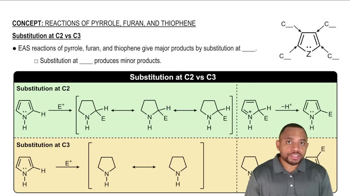
 3:45
3:45