Organic Chemistry
My Course
Learn
Exam Prep
AI Tutor
Study Guides
Textbook Solutions
Flashcards
Explore
Try the app
My Course
Learn
Exam Prep
AI Tutor
Study Guides
Textbook Solutions
Flashcards
Explore
Try the app
Back
Chemical Reactions of Phosphate Anhydrides definitions
You can tap to flip the card.
Phosphate Anhydride
You can tap to flip the card.
👆
Phosphate Anhydride
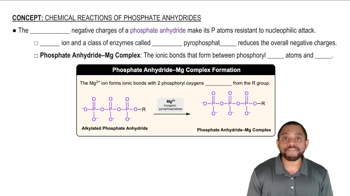
A molecule with multiple phosphate groups linked by oxygen, carrying several negative charges that hinder nucleophilic attack.
Track progress
Control buttons has been changed to "navigation" mode.
1/15
Related flashcards
Recommended videos
Chemical Reactions of Phosphate Anhydrides quiz
Chemical Reactions of Phosphate Anhydrides
10 Terms
1:54
Chemical Reactions of Phosphate Anhydrides Example 2
1
views
3:11
Chemical Reactions of Phosphate Anhydrides Concept 1
2
views
3:20
Chemical Reactions of Phosphate Anhydrides Concept 3
1
views
Terms in this set (15)
Hide definitions
Phosphate Anhydride
A molecule with multiple phosphate groups linked by oxygen, carrying several negative charges that hinder nucleophilic attack.
Magnesium Ion
A divalent cation that forms ionic bonds with phosphoryl oxygens, reducing negative charge and enabling nucleophilic attack.
Inorganic Pyrophosphatase
An enzyme class that assists magnesium ions in lowering the negative charge on phosphate anhydrides.
Nucleophile
A species rich in electrons, often negatively charged, that seeks out electron-deficient atoms for chemical reactions.
Phosphoryl Oxygen
An oxygen atom bonded to phosphorus in phosphate groups, often involved in ionic interactions with magnesium.
Ionic Bond
An electrostatic attraction between oppositely charged ions, such as magnesium and phosphoryl oxygens in complexes.
Adenosine Triphosphate
A high-energy phosphate anhydride, central to cellular energy transfer, with alpha, beta, and gamma phosphate positions.
Gamma Phosphate
The terminal phosphate group in ATP, targeted during nucleophilic acyl substitution reactions.
Nucleophilic Acyl Substitution
A reaction where a nucleophile replaces a leaving group at the acyl position, often at the gamma phosphate of ATP.
Hydrolysis
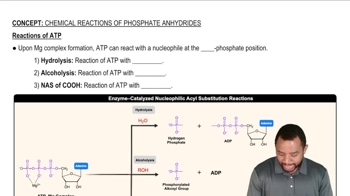
A reaction where water acts as a nucleophile, cleaving ATP to yield ADP and hydrogen phosphate.
Alcoholysis
A reaction where an alcohol acts as a nucleophile, producing a phosphorylated alkoxyl group and ADP from ATP.
Aminolysis
A process where an amine reacts with a phosphorylated carboxyl group, forming an amide and hydrogen phosphate.
Phosphorylated Nucleophile
A product formed when a nucleophile acquires a phosphate group from ATP during substitution reactions.
Hydrogen Phosphate
A product of ATP hydrolysis or aminolysis, containing one hydrogen and two negative charges on the phosphate.
Adenosine Diphosphate
A molecule formed after ATP loses its terminal phosphate, commonly produced in phosphate anhydride reactions.