Back

Reactions of Amino Acids: Esterification definitions

Control buttons has been changed to "navigation" mode.
1/12
  • Amino Acid

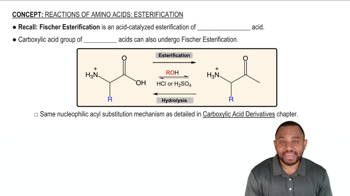
    A molecule containing both amine and carboxylic acid groups, capable of undergoing esterification at the carboxyl site.
  • Fischer Esterification

    An acid-catalyzed process converting a carboxylic acid group into an ester by reaction with an alcohol.
  • Carboxylic Acid

    A functional group characterized by a –COOH moiety, serving as the site for ester formation in amino acids.
  • Ester

    A functional group formed when the hydrogen of a carboxylic acid is replaced by an alkyl or aryl group via esterification.
  • Alcohol

    A compound containing a hydroxyl group, acting as a reactant in the formation of esters from carboxylic acids.
  • Nucleophilic Acyl Substitution

    A mechanism where a nucleophile replaces a leaving group on a carbonyl carbon, central to esterification.
  • Hydrolysis

    A reaction using water and acid to convert an ester back into its parent carboxylic acid.
  • Sulfuric Acid

    A strong acid commonly used to catalyze both esterification and hydrolysis reactions involving amino acids.
  • HCl

    A strong acid that can catalyze the hydrolysis of esters, regenerating carboxylic acids from esters.
  • Functional Group Interconversion

    The transformation of one functional group into another, such as converting a carboxylic acid to an ester.
  • Acid Catalyst

    A substance that increases the rate of esterification or hydrolysis without being consumed in the reaction.
  • Parent Carboxylic Acid

    The original carboxylic acid structure from which an ester is derived and to which it can revert via hydrolysis.