Back

Reactions at the Allylic Position quiz

Control buttons has been changed to "navigation" mode.
1/15
  • What is the allylic position in an organic molecule?

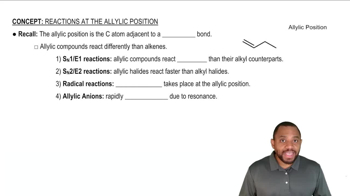
    The allylic position is the carbon atom adjacent to a double bond.
  • Why do allylic compounds react faster than alkyl compounds in SN1 and E1 reactions?

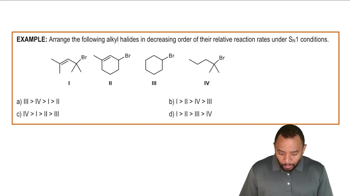
    Allylic compounds react faster because the resulting carbocations are stabilized by resonance.
  • How does resonance affect the stability of allylic carbocations compared to alkyl carbocations?

    Resonance provides greater stabilization to allylic carbocations than hyperconjugation does for alkyl carbocations.
  • What is the relative rate of formation for a tertiary allylic carbocation compared to a tertiary alkyl carbocation?

    A tertiary allylic carbocation forms about 162 times faster than a tertiary alkyl carbocation.
  • Why are allylic protons more acidic than alkyl protons?

    Allylic protons are more acidic because the resulting allylic anion is resonance stabilized, making the conjugate base more stable.
  • What is the typical pKa value for an allylic proton compared to an alkyl proton?

    An allylic proton has a pKa around 44, while an alkyl proton has a pKa around 50.
  • How does the increased acidity of allylic protons affect E2 reactions?

    The increased acidity leads to a higher ratio of elimination products, as the resulting alkenes are resonance stabilized.
  • What is the difference between halogenation of alkenes and allylic halogenation in the presence of radical initiators?

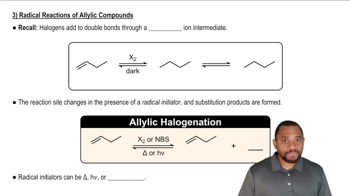
    Halogenation of alkenes adds halogens across the double bond, while allylic halogenation replaces an allylic proton with a halogen using radical initiators.
  • What reagents and conditions are commonly used for allylic bromination?

    NBS (N-bromosuccinimide) with heat, UV light, or peroxides is used to replace an allylic proton with bromine.
  • How does resonance affect the stability of allylic anions compared to alkyl anions?

    Resonance stabilizes allylic anions, making them more stable than alkyl anions.
  • What determines the major product in allylic anion rearrangements with Grignard reagents?

    The major product is determined by Zaitsev's rule, favoring the more substituted (and thus more stable) alkene.
  • What is the outcome when an allylic Grignard reagent reacts with an alkyl halide?

    The Grignard reagent alkylates the allylic position, forming a new carbon-carbon bond at that site.
  • What is allylic oxidation and what reagent is used for it?

    Allylic oxidation selectively oxidizes an allylic alcohol to a carbonyl group using manganese dioxide (MnO2) in methylene chloride.
  • Does allylic oxidation affect the alkene double bond in the molecule?

    No, allylic oxidation leaves the alkene double bond intact while oxidizing the allylic alcohol.
  • Why is manganese dioxide used for allylic oxidation instead of other oxidizing agents?

    Manganese dioxide selectively oxidizes the allylic alcohol without affecting other parts of the molecule, such as the alkene.