Back

Reaction Mechanism definitions

Control buttons has been changed to "navigation" mode.
1/15
  • Mechanism

    Stepwise description of electron movement in reactions, using arrows to show how bonds form and break.
  • Stability

    A measure of how likely a molecule is to resist change; higher values mean lower reactivity.
  • Reactivity

    A tendency of a molecule to undergo chemical change, often driven by instability or charge.
  • Formal Charge

    A calculated value indicating an atom has more or fewer electrons than its ideal bonding preference.
  • Net Dipole

    An overall separation of charge in a molecule due to asymmetrical electron distribution.
  • Partial Charge

    A localized region of slight positive or negative character resulting from uneven electron sharing.
  • Pi Bond

    A weaker type of bond formed by sideways overlap of orbitals, serving as a source of electrons.
  • Steric Effect

    A destabilizing influence caused by atoms being forced into close proximity, such as ring strain.
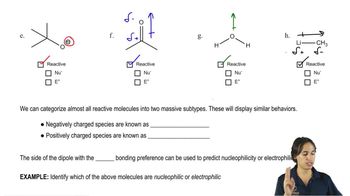
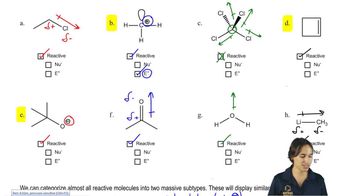
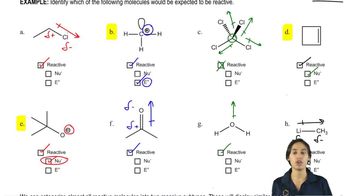
  • Nucleophile

    An electron-rich species, often negatively charged, that seeks positive centers to share electrons.
  • Electrophile

    An electron-poor species, often positively charged, that seeks electrons to achieve stability.
  • Bonding Preference

    The typical number of bonds an atom tends to form to achieve a stable electron configuration.
  • Curved Arrow

    A notation tool indicating the movement of two electrons from a donor to an acceptor in mechanisms.
  • Sigma Bond

    A strong bond formed by direct overlap of orbitals, representing two shared electrons.
  • Heterolytic Cleavage

    A bond-breaking process where both electrons go to one atom, producing ions.
  • Homolytic Cleavage

    A bond-breaking process where each atom receives one electron, resulting in radicals.