Skip to main content
Organic Chemistry
My Course
Learn
Exam Prep
AI Tutor
Study Guides
Textbook Solutions
Flashcards
Explore
Try the app
My Course
Learn
Exam Prep
AI Tutor
Study Guides
Textbook Solutions
Flashcards
Explore
Try the app
Back
Ranking Acidity definitions
You can tap to flip the card.
Acidity
You can tap to flip the card.
👆
Acidity
A measure of how readily a molecule donates a proton, influenced by the stability of its conjugate base.
Track progress
Control buttons has been changed to "navigation" mode.
1/15
Related flashcards
Related practice
Recommended videos
Ranking Acidity quiz
Factors Affecting Acidity
10 Terms
Ranking Acidity quiz #1
Factors Affecting Acidity
35 Terms
Ranking Acidity
3. Acids and Bases
7 problems
Topic
Johnny
Acid Base Equilibrium
3. Acids and Bases
7 problems
Topic
Johnny
3. Acids and Bases - Part 1 of 2
4 topics
10 problems
Chapter
Laura
3. Acids and Bases - Part 2 of 2
3 topics
9 problems
Chapter
Johnny
00:30
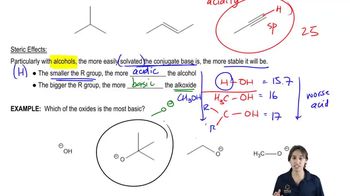
Which of the oxides is the most basic?
3
views
03:09
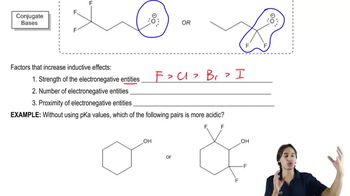
The 3 factors that determine the strength of inductive effects.
6
views
01:54
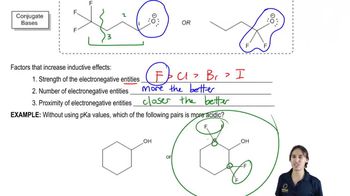
Using Inductive Effect to determine acidity
6
views
Terms in this set (15)
Hide definitions
Acidity
A measure of how readily a molecule donates a proton, influenced by the stability of its conjugate base.
Conjugate Base
The species formed when an acid loses a proton, whose stability determines the acid's strength.
pKa
A numerical value indicating acid strength; lower values correspond to stronger acids.
Element Effect
The influence of the atom directly bonded to hydrogen on acidity, based on electronegativity and atomic size.
Electronegativity
An atom's tendency to attract electrons, affecting how well it stabilizes negative charge in a conjugate base.
Atomic Size
The relative volume of an atom, with larger atoms better dispersing negative charge and stabilizing conjugate bases.
Inductive Effect
The stabilization of negative charge by electronegative atoms not directly bonded to the acidic hydrogen.
Resonance Effect
The delocalization of negative charge across multiple atoms, increasing conjugate base stability and acidity.
Hybridization Effect
The impact of s-character in an orbital on acidity; more s-character means electrons are held closer to the nucleus.
Steric Effect
The influence of bulky groups near the acidic site, with less bulk allowing better solvation and higher acidity.
Solvation
The process by which solvent molecules stabilize ions, affecting the stability of conjugate bases in solution.
Resonance Structure
An alternative Lewis structure showing different possible locations for electrons, contributing to charge delocalization.
s Character
The proportion of an s orbital in a hybrid orbital, with higher values leading to greater acidity.
Alkoxide
A conjugate base derived from an alcohol, featuring a negatively charged oxygen atom.
Proximity
The closeness of electronegative atoms to the acidic site, with nearer atoms exerting stronger inductive effects.
 BackBack

 00:30
00:30