Skip to main content
Organic Chemistry
My Course
Learn
Exam Prep
AI Tutor
Study Guides
Textbook Solutions
Flashcards
Explore
Try the app
My Course
Learn
Exam Prep
AI Tutor
Study Guides
Textbook Solutions
Flashcards
Explore
Try the app
Back
Radical Stability definitions
You can tap to flip the card.
Radical
You can tap to flip the card.
👆
Radical
A species with a single unpaired electron in a partially filled orbital, making it highly reactive and electron deficient.
Track progress
Control buttons has been changed to "navigation" mode.
1/14
Related flashcards
Related practice
Recommended videos
Radical Stability quiz #1
Radical Stability
10 Terms
Radical Stability
11. Radical Reactions
7 problems
Topic
Ernest
Free Radical Halogenation
11. Radical Reactions
7 problems
Topic
Ernest
11. Radical Reactions - Part 1 of 2
4 topics
11 problems
Chapter
Johnny
11. Radical Reactions - Part 2 of 2
5 topics
13 problems
Chapter
Johnny
Guided course
03:43
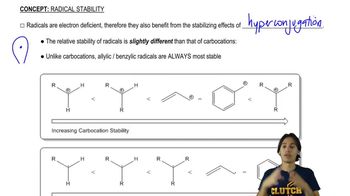
The radical stability trend.
6
views
Guided course
03:25
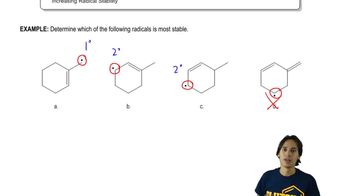
Determine which of the following radicals is the most stable.
6
views
Terms in this set (14)
Hide definitions
Radical
A species with a single unpaired electron in a partially filled orbital, making it highly reactive and electron deficient.
Electron Deficiency
A condition where an atom or molecule lacks a full complement of electrons, leading to high reactivity.
Partially Filled Orbital
An atomic or molecular orbital containing only one electron, contributing to instability in radicals.
Hyperconjugation
An effect where adjacent alkyl groups donate electron density, stabilizing electron-deficient centers like radicals.
R Group
An alkyl substituent attached to a molecule, whose presence increases radical stability via hyperconjugation.
Tertiary Radical
A radical center bonded to three alkyl groups, offering significant but not maximal stability among radicals.
Carbocation
A positively charged carbon species with an empty orbital, used as a comparison for radical stability trends.
Allylic Radical
A radical adjacent to a double bond, stabilized by resonance that delocalizes the unpaired electron.
Benzylic Radical
A radical next to a benzene ring, highly stabilized by resonance with the aromatic system.
Resonance
A phenomenon where electron deficiency is spread over multiple atoms, greatly enhancing radical stability.
Resonance Structure
A different Lewis representation showing alternative electron arrangements, used to depict delocalization in radicals.
Delocalization
The spreading of electron density over several atoms, reducing instability in electron-deficient species.
Stability Trend
The observed order of radical stability, with allylic and benzylic types being most stable due to resonance.
Pauli Exclusion Principle
A rule stating that an orbital can hold a maximum of two electrons with opposite spins, relevant to radical structure.
 BackBack

 03:43
03:43