Skip to main content
Organic Chemistry
My Course
Learn
Exam Prep
AI Tutor
Study Guides
Textbook Solutions
Flashcards
Explore
Try the app
My Course
Learn
Exam Prep
AI Tutor
Study Guides
Textbook Solutions
Flashcards
Explore
Try the app
Back
Radical Selectivity definitions
You can tap to flip the card.
Radical Halogenation
You can tap to flip the card.
👆
Radical Halogenation
A process where halogen atoms replace hydrogens in alkanes via radical intermediates, with selectivity depending on the halogen used.
Track progress
Control buttons has been changed to "navigation" mode.
1/15
Related flashcards
Related practice
Recommended videos
Radical Selectivity quiz
Radical Selectivity
15 Terms
Radical Selectivity
11. Radical Reactions
5 problems
Topic
Johnny
Calculating Radical Yields
11. Radical Reactions
9 problems
Topic
Johnny
11. Radical Reactions - Part 1 of 2
4 topics
11 problems
Chapter
Johnny
11. Radical Reactions - Part 2 of 2
5 topics
13 problems
Chapter
Johnny
00:48
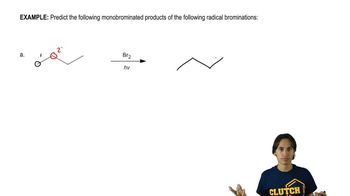
Predict the Product.
4
views
01:02
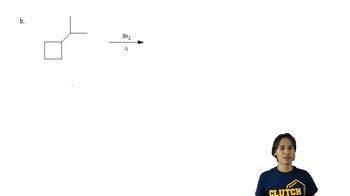
Predict the Product.
7
views
03:03
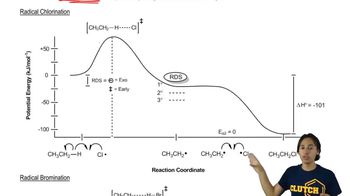
Using the Hammond Postulate to describe radical chlorination.
6
views
Terms in this set (15)
Hide definitions
Radical Halogenation
A process where halogen atoms replace hydrogens in alkanes via radical intermediates, with selectivity depending on the halogen used.
Fluorination
A highly exothermic, nonselective reaction with a large negative enthalpy, often resulting in uncontrollable or explosive outcomes.
Chlorination
A moderately exothermic process yielding mixed products due to limited selectivity, favoring compounds with uniform hydrogen types.
Bromination
A selective, mildly exothermic reaction that targets the most stable radical intermediate, ideal for controlled alkane halogenation.
Iodination
An endothermic, non-spontaneous process generally avoided in radical halogenation due to its positive enthalpy and lack of reactivity.
Enthalpy
A measure of heat change in a reaction; negative values indicate exothermicity, influencing the selectivity of halogenation.
Selectivity
The tendency of a reaction to favor specific sites, such as the most stable radical, over others during halogenation.
Radical Intermediate
A transient species with an unpaired electron formed during halogenation, whose stability guides product distribution.
Transition State
A high-energy configuration during a reaction, whose resemblance to reactants or products affects selectivity.
Hammond Postulate
A principle stating that the structure of the transition state resembles the species (reactant or product) closest in energy.
Propagation Phase
A stage in radical reactions where radicals react with stable molecules to form new radicals and products.
Termination Step
A phase where two radicals combine to form a stable molecule, ending the chain reaction.
Activation Energy
The energy required to initiate a reaction step, such as bond breaking during radical formation.
Racemic Mixture
A 1:1 blend of two enantiomers formed when a reaction produces equal amounts of both stereoisomers.
Rate-Determining Step
The slowest step in a reaction mechanism, controlling the overall reaction rate and often involving radical formation.
 BackBack
 00:48
00:48