Back

Radical Polymerization quiz

Control buttons has been changed to "navigation" mode.
1/15
  • What initiates radical polymerization of alkenes?

    Radical polymerization is initiated by radical initiators like peroxides under heat or UV light.
  • What is the generic formula for a peroxide used as a radical initiator?

    The generic formula for a peroxide is ROOR, where R can be hydrogen or a carbon group.
  • What is the first step in the radical polymerization mechanism?

    The first step is initiation, where the initiator undergoes homolytic cleavage to form radicals.
  • How are radicals formed during the initiation step?

    Radicals are formed when the peroxide initiator undergoes homolytic cleavage, splitting the bond equally so each fragment gets one electron.
  • What happens during the propagation step of radical polymerization?

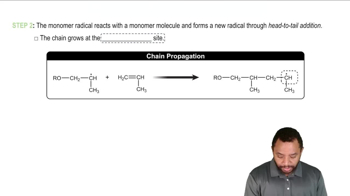
    During propagation, the monomer radical reacts with another monomer molecule via head-to-tail addition, growing the polymer chain.
  • Where does the polymer chain grow during propagation?

    The polymer chain grows at the propagating site, which is the location of the active radical.
  • What are the two main ways termination can occur in radical polymerization?

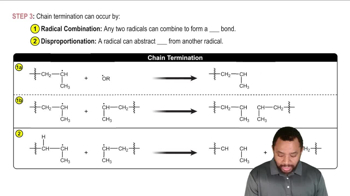
    Termination can occur by combination of two radicals to form a sigma bond or by disproportionation, where a radical abstracts a hydrogen atom.
  • What is disproportionation in the context of radical polymerization termination?

    Disproportionation is when a radical abstracts a hydrogen atom from another radical, forming an alkene and an alkyl group.
  • What is chain transfer in radical polymerization?

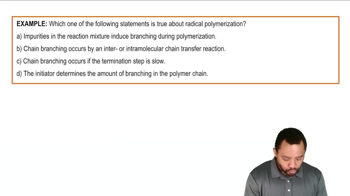
    Chain transfer is a process where the active site of the growing polymer chain shifts, leading to branching.
  • What is the difference between intramolecular and intermolecular chain transfer?

    Intramolecular chain transfer (backbiting) occurs within the same molecule and creates short branches, while intermolecular chain transfer occurs between different molecules and creates long branches.
  • What is backbiting in radical polymerization?

    Backbiting is an intramolecular chain transfer where the radical abstracts a hydrogen from the same molecule, resulting in short branches.
  • How does intermolecular chain transfer affect the polymer structure?

    Intermolecular chain transfer creates long branches by transferring the radical to a different polymer chain.
  • How does branching affect the physical properties of polymers?

    Branching changes the physical properties of polymers, such as density and melting point.
  • What is the role of heat or UV light in radical polymerization?

    Heat or UV light provides the energy needed for the initiator to undergo homolytic cleavage and generate radicals.
  • Why is radical polymerization considered a chain-growth polymerization mechanism?

    It is considered chain-growth because the polymer grows by successive addition of monomer units to the active radical site.