Skip to main content
Organic Chemistry
My Course
Learn
Exam Prep
AI Tutor
Study Guides
Textbook Solutions
Flashcards
Explore
Try the app
My Course
Learn
Exam Prep
AI Tutor
Study Guides
Textbook Solutions
Flashcards
Explore
Try the app
Back
Primary Structure of Nucleic Acids definitions
You can tap to flip the card.
Primary Structure
You can tap to flip the card.
👆
Primary Structure
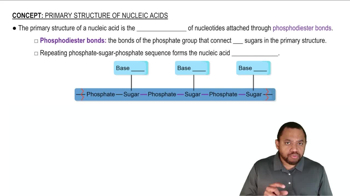
A linear sequence of nucleotides joined by phosphodiester bonds, determining the unique identity of a nucleic acid.
Track progress
Control buttons has been changed to "navigation" mode.
1/12
Related flashcards
Related practice
Recommended videos
Primary Structure of Nucleic Acids quiz
Primary Structure of Nucleic Acids
15 Terms
Primary Structure of Nucleic Acids
34. Nucleic Acids
5 problems
Topic
Base Pairing
34. Nucleic Acids
5 problems
Topic
34. Nucleic Acids - Part 1 of 2
4 topics
12 problems
Chapter
34. Nucleic Acids - Part 2 of 2
3 topics
9 problems
Chapter
Guided course
1:43
Primary Structure of Nucleic Acids Concept 2
2
views
Guided course
1:41
Primary Structure of Nucleic Acids Concept 1
2
views
Guided course
1:04
Primary Structure of Nucleic Acids Example 1
1
views
Terms in this set (12)
Hide definitions
Primary Structure
A linear sequence of nucleotides joined by phosphodiester bonds, determining the unique identity of a nucleic acid.
Nucleotide
A molecular unit composed of a phosphate group, a pentose sugar, and a nitrogenous base, forming nucleic acid chains.
Phosphodiester Bond
A covalent linkage connecting the phosphate group of one nucleotide to the sugar of another, forming the backbone.
Phosphate Group
A chemical group providing negative charge and directionality, found at the 5' end of nucleic acid chains.
Pentose Sugar
A five-carbon ring structure forming part of the nucleotide backbone, connecting to both phosphate and base.
Nitrogenous Base
A variable component attached to the sugar, whose sequence encodes genetic information and determines primary structure.
Backbone
A repeating chain of alternating phosphate and sugar groups, providing structural support to nucleic acids.
Directionality
A property indicating that nucleic acid chains are read from the 5' end to the 3' end, based on chemical groups present.
5' End
The terminus of a nucleic acid strand featuring a free phosphate group, marking the starting point for reading sequences.
3' End
The terminus of a nucleic acid strand featuring a free hydroxyl group, marking the endpoint for reading sequences.
Hydroxyl Group
A functional group (-OH) present at the 3' end of a nucleic acid, crucial for chain elongation and directionality.
Sequence
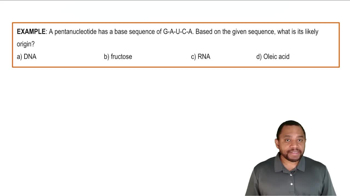
The specific order of nitrogenous bases along a nucleic acid, determining genetic information and protein coding.
 BackBack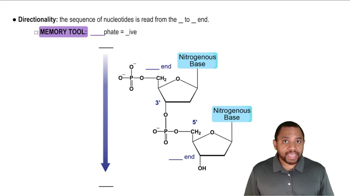
 1:43
1:43