Back

Polar Amino Acids quiz

Control buttons has been changed to "navigation" mode.
1/15
  • What are the two main methods for categorizing amino acids?

    The two main methods are structural categorization and functional categorization.
  • What does structural categorization of amino acids focus on?

    It focuses on grouping amino acids based on structural similarities in their side chains, such as aliphatic, aromatic, sulfur-containing, etc.
  • Why can structural categorization of amino acids be problematic?

    Because some amino acids fit into more than one category due to overlapping structural features.
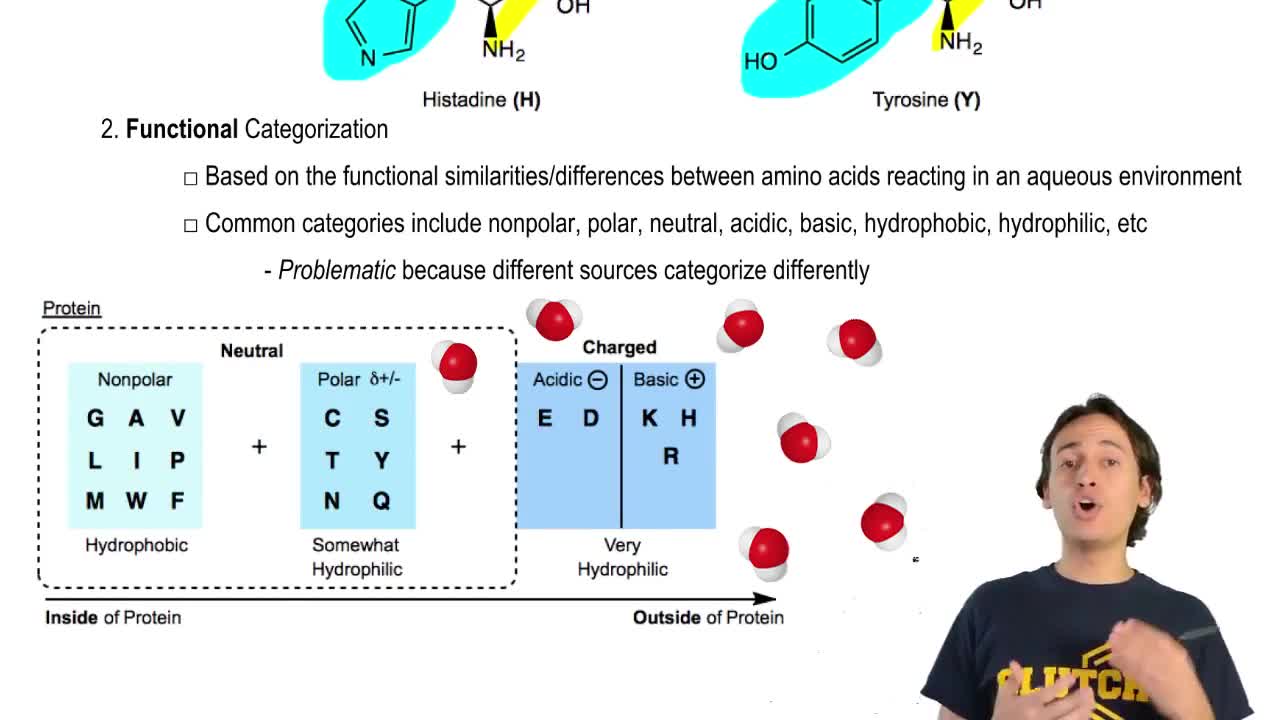
  • What is functional categorization of amino acids based on?

    It is based on how amino acids react in water, classifying them by properties like polarity, charge, and hydrophobicity.
  • What terms are commonly used in functional categorization of amino acids?

    Terms like non-polar, polar, neutral, acidic, basic, hydrophobic, and hydrophilic are commonly used.
  • How are amino acids grouped in the functional system from most hydrophobic to hydrophilic?

    They are grouped starting with non-polar (most hydrophobic), then polar, and finally charged (most hydrophilic) amino acids.
  • What is the relationship between the terms 'neutral,' 'non-polar,' and 'polar' in amino acid categorization?

    'Neutral' is an umbrella term that includes both non-polar and polar amino acids.
  • How are charged amino acids further subdivided in functional categorization?

    Charged amino acids are subdivided into acidic and basic categories.
  • Why is functional categorization considered more complex and commonly tested?

    Because it involves understanding amino acids' behavior in aqueous environments and their solubility characteristics.
  • What is the main advantage of using functional categorization over structural categorization?

    Functional categorization is more helpful for understanding amino acid behavior in biological systems and is more commonly tested.
  • How do non-polar amino acids behave in water?

    Non-polar amino acids are hydrophobic and tend to avoid water, often folding inside proteins to stay away from the aqueous environment.
  • How do polar amino acids interact with water compared to non-polar ones?

    Polar amino acids are more hydrophilic and can interact with water, but are not as water-loving as charged amino acids.
  • What is the behavior of charged amino acids in water?

    Charged amino acids are highly hydrophilic and prefer to be on the outside of proteins, interacting with water molecules.
  • Why might categorization systems for amino acids differ between textbooks or professors?

    Because there is no universally agreed-upon method, and different sources may use slightly different terms or groupings.
  • What should students do if their course uses a different amino acid categorization system?

    Students should adapt by learning the preferred terminology and classification method required by their professor or textbook.