Back

Photochemical Electrocyclic Reactions quiz

Control buttons has been changed to "navigation" mode.
1/15
  • What type of reaction is a photochemical electrocyclic reaction?

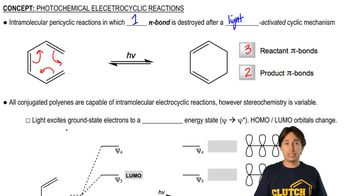
    It is an intramolecular pericyclic reaction activated by light, where one pi bond is destroyed and a new sigma bond is formed.
  • What is the key difference between photochemical and thermal electrocyclic reactions?

    Photochemical reactions are activated by light, which excites electrons, while thermal reactions are driven by heat.
  • What happens to the number of pi bonds during a photochemical electrocyclic reaction?

    One pi bond is destroyed during the reaction.
  • What is formed in place of the destroyed pi bond in a photochemical electrocyclic reaction?

    A new sigma bond is formed.
  • Are photochemical electrocyclic reactions limited to specific types of polyenes?

    No, every conjugated polyene is capable of undergoing photochemical electrocyclic reactions.
  • What theory is used to predict the stereochemistry of photochemical electrocyclic reactions?

    Frontier Molecular Orbital Theory is used to predict the stereochemistry.
  • What role does light play in photochemical electrocyclic reactions?

    Light excites ground state electrons to a higher energy state, altering the molecular orbitals involved.
  • How does light affect the HOMO and LUMO in a photochemical electrocyclic reaction?

    Light changes the identity of the HOMO and LUMO by promoting an electron to a higher energy orbital.
  • Which molecular orbital is most important for determining the stereochemistry in an electrocyclic reaction?

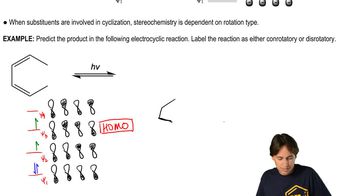
    The HOMO (Highest Occupied Molecular Orbital) is most important for determining stereochemistry.
  • In a diene, which orbitals are typically filled before light activation?

    Psi 1 and Psi 2 are filled, making Psi 2 the HOMO and Psi 3 the LUMO.
  • What happens to the electron configuration of a diene after light activation?

    An electron is promoted to a higher energy state, making Psi 3 the new HOMO and Psi 4 the new LUMO.
  • Is the LUMO relevant for the mechanism of photochemical electrocyclic reactions?

    No, the LUMO is irrelevant because the reaction is intramolecular and only involves the HOMO.
  • Why must the HOMO be reconsidered when drawing the stereochemistry of a photochemical electrocyclic reaction?

    Because light changes the identity of the HOMO, affecting how the orbitals overlap and thus the stereochemistry.
  • What is the general outcome of a photochemical electrocyclic reaction in terms of molecular structure?

    A new ring is formed as a result of the reaction.
  • What will the next video in the series demonstrate regarding photochemical electrocyclic reactions?

    It will show how to draw the stereochemistry of an electrocyclic reaction influenced by light from scratch.