Skip to main content
Organic Chemistry
My Course
Learn
Exam Prep
AI Tutor
Study Guides
Textbook Solutions
Flashcards
Explore
Try the app
My Course
Learn
Exam Prep
AI Tutor
Study Guides
Textbook Solutions
Flashcards
Explore
Try the app
Back
Phosphoglycerides definitions
You can tap to flip the card.
Phosphoglyceride
You can tap to flip the card.
👆
Phosphoglyceride
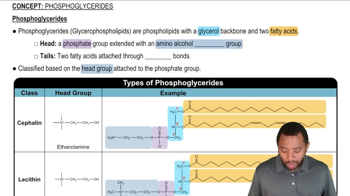
A hydrolyzable phospholipid with a glycerol backbone, two fatty acid chains, and a phosphate group linked to an amino alcohol.
Track progress
Control buttons has been changed to "navigation" mode.
1/15
Related flashcards
Related practice
Recommended videos
Phosphoglycerides quiz
Phosphoglycerides
10 Terms
Phosphoglycerides
32. Lipids
5 problems
Topic
Sphingomyelins
32. Lipids
5 problems
Topic
32. Lipids - Part 1 of 3
4 topics
12 problems
Chapter
32. Lipids - Part 2 of 3
4 topics
12 problems
Chapter
32. Lipids - Part 3 of 3
2 topics
6 problems
Chapter
Guided course
2:32
Phosphoglycerides Concept 3
3
views
Guided course
2:26
Phosphoglycerides Concept 1
2
views
Guided course
2:22
Phosphoglycerides Concept 2
2
views
Terms in this set (15)
Hide definitions
Phosphoglyceride
A hydrolyzable phospholipid with a glycerol backbone, two fatty acid chains, and a phosphate group linked to an amino alcohol.
Phospholipid
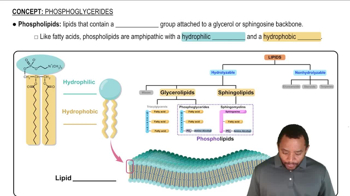
A lipid containing a phosphate group, forming the main component of cell membranes due to its amphiphatic nature.
Glycerol Backbone
A three-carbon structure serving as the foundation for attaching fatty acids and a phosphate group in certain lipids.
Fatty Acid
A hydrocarbon chain with a carboxyl group, forming the hydrophobic tail region in phosphoglycerides.
Phosphate Group
A polar, negatively charged moiety that links the glycerol backbone to the head group in phosphoglycerides.
Amino Alcohol
A nitrogen-containing group, such as ethanolamine or choline, attached to the phosphate group in phosphoglycerides.
Cephalin
A phosphoglyceride subclass with ethanolamine as the head group, featuring a positively charged nitrogen.
Lecithin
A phosphoglyceride subclass with choline as the head group, where nitrogen is bonded to three methyl groups.
Lipid Bilayer
A double-layered structure formed by amphiphatic lipids, providing the basic framework of cell membranes.
Hydrophilic Head
The polar region of a phosphoglyceride, consisting of a phosphate group and head group, interacting with water.
Hydrophobic Tail
The nonpolar region of a phosphoglyceride, made of fatty acid chains, avoiding water contact.
Ester Bond
A linkage formed between the glycerol backbone and fatty acids in phosphoglycerides.
Sphingomyelin
A phospholipid with a sphingosine backbone, a fatty acid, and a phosphate group attached to an amino alcohol.
Lauric Acid
A saturated fatty acid with 12 carbons and no double bonds, often found in phosphoglyceride structures.
Amphiphatic Molecule
A compound containing both polar (hydrophilic) and nonpolar (hydrophobic) regions, enabling bilayer formation.
 BackBack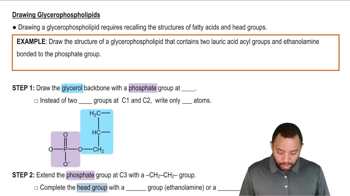
 2:32
2:32