Back

Peptide Sequencing: Edman Degradation quiz

Control buttons has been changed to "navigation" mode.
1/15
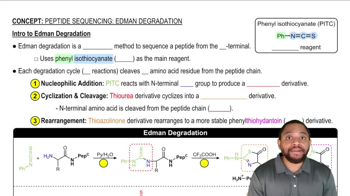
  • What is the main reagent used in Edman degradation for peptide sequencing?

    Phenylisothiocyanate (PITC) is the main reagent used in Edman degradation.
  • From which end of the peptide does Edman degradation sequence amino acids?

    Edman degradation sequences peptides from the N-terminal end.
  • What is the first step in the Edman degradation process?

    The first step is nucleophilic addition, where the amino group attacks PITC's carbon.
  • What derivative is formed after the nucleophilic addition in Edman degradation?

    A thiourea (or urea) derivative is formed after nucleophilic addition.
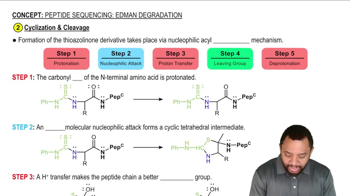
  • What happens during the cyclization and cleavage step of Edman degradation?

    The thiourea derivative cyclizes into a thiazolinone, and the N-terminal amino acid is cleaved from the peptide chain.
  • How is the thiazolinone derivative converted to a stable product in Edman degradation?

    Acidic hydrolysis rearranges the thiazolinone to a stable phenylthiohydantoin (PTH) derivative.
  • How is the identity of the cleaved amino acid determined in Edman degradation?

    The PTH derivative is identified using chromatographic methods.
  • What mechanism is involved in the cyclization step of Edman degradation?

    Cyclization occurs via a nucleophilic acyl substitution mechanism.
  • What role does proton transfer play in the nucleophilic addition step?

    Proton transfer neutralizes charges formed during nucleophilic attack, stabilizing the intermediate.
  • What is the purpose of acidic hydrolysis in the rearrangement step?

    Acidic hydrolysis opens the thiazolinone ring and facilitates rearrangement to the PTH derivative.
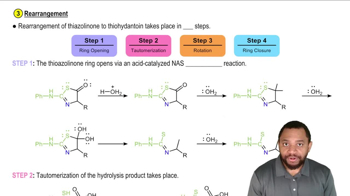
  • What are the four steps in the rearrangement of thiazolinone to thiohydantoin?

    The steps are ring opening, tautomerization, rotation, and ring closure.
  • What type of reaction opens the thiazolinone ring during rearrangement?

    An acid-catalyzed nucleophilic acyl substitution (NAS) hydrolysis reaction opens the ring.
  • What is tautomerization in the context of Edman degradation rearrangement?

    Tautomerization converts the enol-like form (with SH) to the keto form (with double-bonded S).
  • How is the final cyclic PTH structure formed in Edman degradation?

    Ring closure occurs via an acid-catalyzed intramolecular NAS reaction, followed by proton transfer and water elimination.
  • Why is Edman degradation important for protein chemistry?

    It allows sequential identification of amino acids in peptides, helping elucidate protein structure.