Organic Chemistry
My Course
Learn
Exam Prep
AI Tutor
Study Guides
Textbook Solutions
Flashcards
Explore
Try the app
My Course
Learn
Exam Prep
AI Tutor
Study Guides
Textbook Solutions
Flashcards
Explore
Try the app
Back
Oxidation of Alcohols quiz
You can tap to flip the card.
What is the main function of an oxidizing agent in organic chemistry?
You can tap to flip the card.
👆
What is the main function of an oxidizing agent in organic chemistry?
An oxidizing agent increases the number of bonds to oxygen in a molecule.
Track progress
Control buttons has been changed to "navigation" mode.
1/15
Related flashcards
Related practice
Recommended videos
Oxidation of Alcohols definitions
Oxidation of Alcohols
12 Terms
19. Aldehydes and Ketones:Nucleophilic Addition - Part 1 of 3
5 topics
14 problems
Chapter
Johnny
19. Aldehydes and Ketones:Nucleophilic Addition - Part 2 of 3
1 topic
13 problems
Chapter
Johnny
19. Aldehydes and Ketones:Nucleophilic Addition - Part 3 of 3
2 topics
13 problems
Chapter
Ernest
Guided course
01:52
Reagents
4
views
Guided course
05:53
Strong oxidizing agents
3
views
Guided course
03:40
Strong oxidizing agents
4
views
Terms in this set (15)
Hide definitions
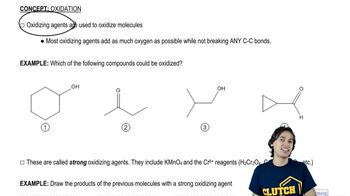
What is the main function of an oxidizing agent in organic chemistry?
An oxidizing agent increases the number of bonds to oxygen in a molecule.
What is the general rule for oxidizing agents regarding carbon-carbon bonds?
Oxidizing agents add as much oxygen as possible without breaking carbon-carbon bonds.
Which type of reagent is used to oxidize molecules by adding bonds to oxygen?
Oxidizing agents are used to add bonds to oxygen during oxidation.
Are all oxidizing agents incapable of breaking carbon-carbon bonds?
No, some oxidizing agents like ozonolysis can break carbon-carbon bonds, but most do not.
What is a key difference between ozonolysis and other oxidizing agents discussed in this topic?
Ozonolysis can break carbon-carbon bonds, while the oxidizing agents in this topic do not.
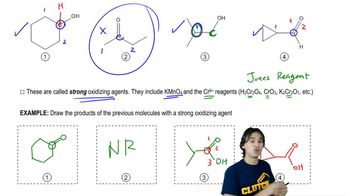
What should you look for when determining if a molecule can be oxidized without breaking carbon-carbon bonds?
Check if you can add more bonds to oxygen without breaking any carbon-carbon bonds.
What is the main goal when using oxidizing agents in organic reactions?
The goal is to maximize the addition of oxygen to the molecule without disrupting carbon-carbon bonds.
How does the concept of oxidizing agents in organic chemistry differ from general chemistry?
In organic chemistry, oxidizing agents simply add oxygen bonds, making the concept less complicated than in general chemistry.
What happens to the oxidizing agent during the oxidation process?
The oxidizing agent itself gets reduced as it oxidizes the target molecule.
Why is it important to avoid breaking carbon-carbon bonds during oxidation in this topic?
Breaking carbon-carbon bonds changes the structure of the molecule, which is not the focus of this topic.
Can you use the general rule of oxidation even if you don't know the mechanism?
Yes, you can apply the rule of adding oxygen without breaking carbon-carbon bonds regardless of the mechanism.
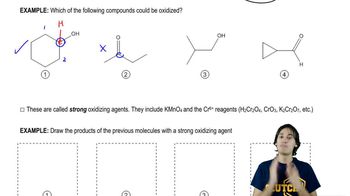
What is the first step in identifying which molecules can be oxidized in a practice problem?
Determine which molecules can have more bonds to oxygen added without breaking carbon-carbon bonds.
What is the focus of the oxidation of alcohols topic regarding oxidizing agents?
The focus is on oxidizing agents that do not break carbon-carbon bonds.
What is a common misconception about oxidizing agents in organic chemistry?
A common misconception is that all oxidizing agents break carbon-carbon bonds, but most do not.
What should you remember about oxidizing agents when studying organic chemistry?
Remember that oxidizing agents are used to add oxygen bonds to molecules without breaking carbon-carbon bonds.