Organic Chemistry
My Course
Learn
Exam Prep
AI Tutor
Study Guides
Textbook Solutions
Flashcards
Explore
Try the app
My Course
Learn
Exam Prep
AI Tutor
Study Guides
Textbook Solutions
Flashcards
Explore
Try the app
Back
Organometallics on Ketones quiz
You can tap to flip the card.
What is the primary role of organometallics in reactions with ketones and aldehydes?
You can tap to flip the card.
👆
What is the primary role of organometallics in reactions with ketones and aldehydes?
Organometallics act as strong nucleophiles, attacking the carbonyl carbon in nucleophilic addition reactions.
Track progress
Control buttons has been changed to "navigation" mode.
1/15
Related flashcards
Related practice
Recommended videos
Organometallics on Ketones definitions
Organometallics on Ketones
14 Terms
19. Aldehydes and Ketones:Nucleophilic Addition - Part 1 of 3
5 topics
14 problems
Chapter
Johnny
19. Aldehydes and Ketones:Nucleophilic Addition - Part 2 of 3
1 topic
13 problems
Chapter
Johnny
19. Aldehydes and Ketones:Nucleophilic Addition - Part 3 of 3
2 topics
13 problems
Chapter
Ernest
Guided course
03:57
Nucleophilic Addition on Ketones and Aldehydes
2
views
Guided course
03:21
Organometallic on Aldehyde
2
views
Terms in this set (15)
Hide definitions
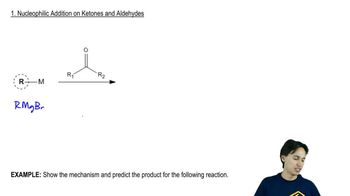
What is the primary role of organometallics in reactions with ketones and aldehydes?
Organometallics act as strong nucleophiles, attacking the carbonyl carbon in nucleophilic addition reactions.
Name two common types of organometallic reagents used with ketones.
Grignard reagents (RMgBr) and organolithium reagents (RLi) are commonly used.
How are Grignard reagents typically represented in chemical notation?
Grignard reagents are represented as RMgBr, where R is an alkyl group and MgBr is the metal component.
What is the general structure of an organolithium reagent?
Organolithium reagents are written as RLi, with R as the alkyl group and Li as the metal.
Why are organometallics considered strong nucleophiles?
They have an ionic bond with a strong dipole toward the carbon, making the carbon highly nucleophilic.
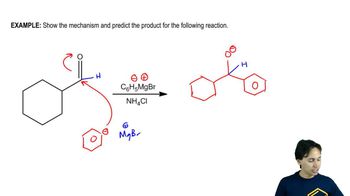
What happens when the R- from an organometallic attacks a carbonyl group?
The R- attacks the partially positive carbon, forming a tetrahedral intermediate.
What is the charge distribution in ionized organometallics like Grignard and organolithium reagents?
The carbon group (R-) is negative, while the metal (MgBr+ or Li+) is positive.
What is the product after the nucleophilic addition of an organometallic to a ketone followed by protonation?
The product is a substituted alcohol with a new R group attached to the central carbon.
What intermediate is formed during the reaction of organometallics with ketones?
A tetrahedral intermediate is formed after the nucleophilic attack.
What is the final step in the mechanism after the tetrahedral intermediate is formed?
A protonation step occurs, converting the intermediate into an alcohol.
What is the significance of the strong dipole in organometallic reagents?
It makes the carbon highly nucleophilic, enabling it to attack electrophilic carbonyl carbons.
What type of bond exists between the R group and the metal in organometallics?
An ionic bond exists, with a strong dipole toward the carbon.
What is always attached to the central carbon in the alcohol product after organometallic addition?
The new R group from the organometallic reagent is attached to the central carbon.
What should you expect as the main product when adding an organometallic to a ketone or aldehyde?
You should expect an alcohol with a new R group added to the carbonyl carbon.
Why are organometallic reactions considered easy to predict in terms of mechanism?
Their strong nucleophilic properties and predictable behavior make arrow-pushing straightforward.