Skip to main content
Organic Chemistry
My Course
Learn
Exam Prep
AI Tutor
Study Guides
Textbook Solutions
Flashcards
Explore
Try the app
My Course
Learn
Exam Prep
AI Tutor
Study Guides
Textbook Solutions
Flashcards
Explore
Try the app
Back
Organic Chemistry Reactions definitions
You can tap to flip the card.
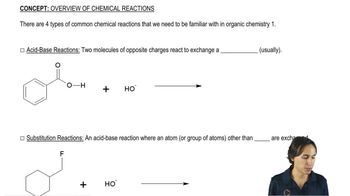
Acid-Base Reaction
You can tap to flip the card.
👆
Acid-Base Reaction
Interaction where molecules of opposite charges exchange a proton, typically involving hydrogen ion transfer.
Track progress
Control buttons has been changed to "navigation" mode.
1/13
Related flashcards
Related practice
Recommended videos
Organic Chemistry Reactions quiz #1
Overview of Chemical Reactions
39 Terms
Organic Chemistry Reactions quiz #2
Overview of Chemical Reactions
38 Terms
Organic Chemistry Reactions quiz #3
Overview of Chemical Reactions
39 Terms
Organic Chemistry Reactions
3. Acids and Bases
1 problem
Topic
Reaction Mechanism
3. Acids and Bases
7 problems
Topic
Johnny
3. Acids and Bases - Part 1 of 2
4 topics
10 problems
Chapter
Laura
3. Acids and Bases - Part 2 of 2
3 topics
9 problems
Chapter
Johnny
01:34
Recognizing Substitution Reactions.
17
views
02:43
Recognizing Acid-Base Reactions.
13
views
1
rank
00:40
Recognizing Elimination Reactions.
7
views
Terms in this set (13)
Hide definitions
Acid-Base Reaction
Interaction where molecules of opposite charges exchange a proton, typically involving hydrogen ion transfer.
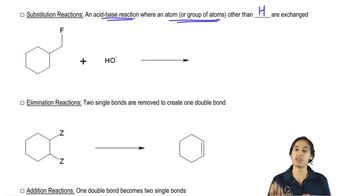
Substitution Reaction
Process where an atom or group in a molecule is replaced by another atom or group, excluding hydrogen.
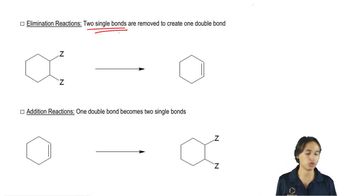
Elimination Reaction
Transformation converting two single (sigma) bonds into one double (pi) bond, reducing the total number of bonds.
Addition Reaction
Conversion of one double (pi) bond into two single (sigma) bonds, increasing the number of single bonds.
Proton
Hydrogen nucleus lacking electrons and neutrons, often exchanged in acid-base processes.
Sigma Bond
Single covalent bond formed by direct overlap of atomic orbitals, present in both single and multiple bonds.
Pi Bond
Bond formed by sideways overlap of p orbitals, found in double and triple bonds, less strong than sigma bonds.
Dipole Moment
Measure of charge separation in a bond, indicating uneven electron distribution between atoms.
Electronegativity
Tendency of an atom to attract electrons in a chemical bond, influencing bond polarity.
Partial Charge
Slight positive or negative charge on an atom due to unequal electron sharing in a bond.
Negative Charge
Excess of electrons on an atom or group, often initiating reactions by attacking positive centers.
Positive Charge
Deficiency of electrons on an atom or group, making it susceptible to attack by electron-rich species.
Hydrogen Ion
Proton released or accepted during acid-base reactions, central to many organic transformations.
 BackBack

 01:34
01:34