Back

Nitrogenous Nucleophiles quiz

Control buttons has been changed to "navigation" mode.
1/15
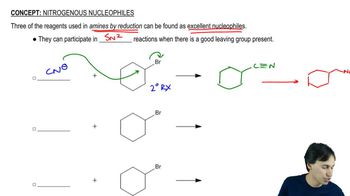
  • What type of reaction allows nitrogen nucleophiles to substitute alkyl halides to eventually form primary amines?

    Nucleophilic substitution (SN2) reactions allow nitrogen nucleophiles to substitute alkyl halides, leading to primary amines after further reduction.
  • Which three nitrogen-containing nucleophiles are commonly used in SN2 reactions to synthesize primary amines from alkyl halides?

    Cyanide (CN⁻), nitrite (NO₂⁻), and azide (N₃⁻) are commonly used nitrogen nucleophiles in SN2 reactions.
  • What is the mechanism by which SN2 reactions proceed when using nitrogen nucleophiles?

    SN2 reactions proceed via a backside attack, where the nucleophile attacks the carbon opposite the leaving group, displacing it.
  • What is the product when an alkyl halide reacts with cyanide ion (CN⁻) in an SN2 reaction?

    The product is a nitrile, where the carbon previously bonded to the halide is now bonded to a cyano group (C≡N).
  • How can a nitrile group (C≡N) be converted into a primary amine?

    A nitrile can be reduced to a primary amine using common reducing agents such as catalytic hydrogenation.
  • Which nucleophile can be used to introduce a nitro group (NO₂) via SN2, and how is the resulting nitro compound converted to an amine?

    Nitrite ion (NO₂⁻) can introduce a nitro group, which can then be reduced to an amine using reducing agents like tin(II) chloride (SnCl₂).
  • What is a chemoselective reagent for reducing nitro groups to amines?

    Tin(II) chloride (SnCl₂) is a chemoselective reagent that specifically reduces nitro groups to amines.
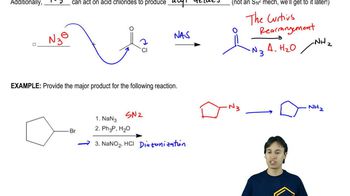
  • Which nucleophile can be used to introduce an azide group (N₃) via SN2, and what is the next step to obtain a primary amine?

    Azide ion (N₃⁻) can introduce an azide group, which is then reduced to a primary amine using triphenylphosphine and water.
  • Why can't common reducing agents be used to reduce azides to amines?

    Common reducing agents are not effective for azides; instead, triphenylphosphine and water are required for this transformation.
  • What type of reaction forms acyl azides from acid chlorides and azide ion (N₃⁻)?

    Nucleophilic acyl substitution (NAS) forms acyl azides from acid chlorides and azide ion.
  • What rearrangement converts acyl azides to amines, and what are the required conditions?

    The Curtius rearrangement converts acyl azides to amines using heat and water.
  • Why is it advantageous to start with alkyl halides rather than highly oxidized nitrogen compounds when synthesizing amines?

    Starting with alkyl halides allows for more versatile and accessible pathways to amines using nucleophilic substitution and reduction.
  • What is the role of a good leaving group in SN2 reactions involving nitrogen nucleophiles?

    A good leaving group, such as bromide, is necessary for the nitrogen nucleophile to successfully displace it via backside attack.
  • What is the general sequence of steps to synthesize a primary amine from an alkyl halide using a nitrogen nucleophile?

    First, perform SN2 substitution with a nitrogen nucleophile to introduce a nitrogen-containing group, then reduce that group to a primary amine.
  • What is the main takeaway regarding the use of nitrogenous nucleophiles in organic synthesis of amines?

    Nitrogenous nucleophiles provide multiple pathways to synthesize primary amines from alkyl halides without starting from highly oxidized nitrogen compounds.