Back

Negishi Coupling Reaction quiz

Control buttons has been changed to "navigation" mode.
1/15
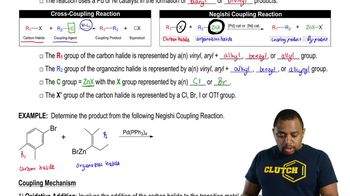
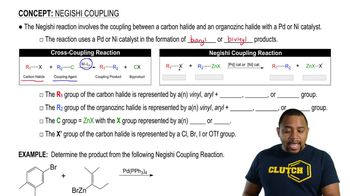
  • What two types of reactants are coupled in the Negishi coupling reaction?

    A carbon halide (R1X) and an organozinc halide (R2ZnX) are coupled in the Negishi reaction.
  • Which catalysts are commonly used in the Negishi coupling reaction?

    Palladium or nickel catalysts are commonly used in the Negishi coupling reaction.
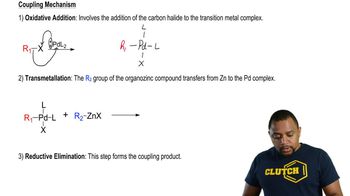
  • What are the three main steps in the Negishi coupling reaction mechanism?

    The three main steps are oxidative addition, transmetalation, and reductive elimination.
  • During oxidative addition, what happens to the carbon-halogen bond?

    The carbon-halogen bond breaks, and both the carbon and halogen become bonded to the transition metal catalyst.
  • What occurs during the transmetalation step of the Negishi reaction?

    The R2 group from the organozinc halide transfers to the metal complex, while the halogen moves from the metal complex to zinc.
  • What is the final product of the Negishi coupling reaction?

    The final product is a coupled molecule where R1 and R2 are joined, typically forming a biaryl or bivinyl compound.
  • What happens to the transition metal catalyst after reductive elimination?

    The catalyst is regenerated and can re-enter the catalytic cycle.
  • What are typical groups that R1 can represent in the carbon halide reactant?

    R1 can be a vinyl, aryl, alkyl, benzyl, or allyl group.
  • What types of groups can R2 represent in the organozinc halide?

    R2 can be an alkyl, benzyl, or alkenyl group.
  • What is the main driving force for the Negishi coupling reaction?

    The main driving forces are the formation of a more stable, conjugated product and maintaining the transition metal's electron count.
  • What electron rule does the transition metal catalyst aim to follow in the Negishi reaction?

    The transition metal aims to follow the 18 or 16 electron rule.
  • What is the byproduct formed when the organozinc halide reacts in the Negishi coupling?

    The byproduct is a zinc compound bonded to two halogens (ZnX2).
  • In the Negishi reaction, what happens to the halogen from the carbon halide?

    The halogen is transferred to the zinc atom during the transmetalation step.
  • Why is the Negishi coupling considered a cross-coupling reaction?

    It joins two different organic groups (R1 and R2) from separate reactants to form a new carbon-carbon bond.
  • What is the simplest way to describe the overall transformation in the Negishi coupling reaction?

    A carbon halide and an organozinc halide lose their halide and ZnX groups, respectively, and their organic groups (R1 and R2) combine to form the product.