Skip to main content
Organic Chemistry
My Course
Learn
Exam Prep
AI Tutor
Study Guides
Textbook Solutions
Flashcards
Explore
Try the app
My Course
Learn
Exam Prep
AI Tutor
Study Guides
Textbook Solutions
Flashcards
Explore
Try the app
Back
Naming Nucleosides and Nucleotides definitions
You can tap to flip the card.
Nucleoside
You can tap to flip the card.
👆
Nucleoside
A molecule formed by attaching a nitrogenous base to a sugar via a glycosidic bond, lacking any phosphate group.
Track progress
Control buttons has been changed to "navigation" mode.
1/14
Related flashcards
Related practice
Recommended videos
Naming Nucleosides and Nucleotides quiz
Naming Nucleosides and Nucleotides
30 Terms
Naming Nucleosides and Nucleotides
34. Nucleic Acids
5 problems
Topic
Hydrolysis of Nucleosides
34. Nucleic Acids
5 problems
Topic
34. Nucleic Acids - Part 1 of 2
4 topics
12 problems
Chapter
34. Nucleic Acids - Part 2 of 2
3 topics
9 problems
Chapter
Guided course
1:21
Naming Nucleosides and Nucleotides Concept 2
4
views
Guided course
1:53
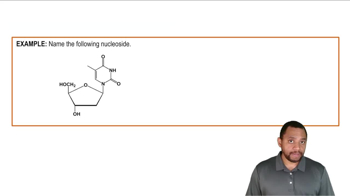
Naming Nucleosides and Nucleotides Example 1
6
views
Guided course
2:19
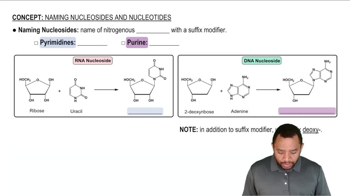
Naming Nucleosides and Nucleotides Concept 1
6
views
Terms in this set (14)
Hide definitions
Nucleoside
A molecule formed by attaching a nitrogenous base to a sugar via a glycosidic bond, lacking any phosphate group.
Nucleotide
A compound consisting of a nucleoside linked to a phosphate group at the 5' carbon of the sugar.
Nitrogenous Base
A ring structure, either purine or pyrimidine, that pairs with a sugar to form nucleosides.
Pyrimidine
A single-ring nitrogenous base category, including cytosine, uracil, and thymine, with nucleosides ending in 'idine'.
Purine
A double-ring nitrogenous base category, including adenine and guanine, with nucleosides ending in 'osine'.
Ribose
A five-carbon sugar present in RNA nucleosides, distinguishing them from DNA nucleosides.
Deoxyribose
A five-carbon sugar lacking an oxygen at the 2' position, found in DNA nucleosides and nucleotides.
Glycosidic Bond
A linkage formed between the nitrogen of a base and the anomeric carbon of a sugar in nucleosides.
Phosphate Group
A chemical group added to the 5' carbon of a nucleoside to form a nucleotide.
Monophosphate
A single phosphate group attached to a nucleoside, signifying the nucleotide form.
5' Carbon
The specific carbon on the sugar where the phosphate group attaches in nucleotide formation.
Deoxy Prefix
A naming modifier indicating the presence of deoxyribose in DNA nucleosides and nucleotides.
One-Letter Abbreviation
A single character code representing each nitrogenous base, used in nucleotide shorthand.
Suffix Modifier
A naming change applied to the base name, such as 'idine' for pyrimidines and 'osine' for purines in nucleosides.
 BackBack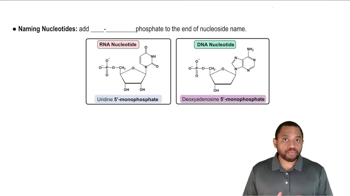
 1:21
1:21