Back

Mutarotation definitions

Control buttons has been changed to "navigation" mode.
1/15
  • Anomeric Carbon

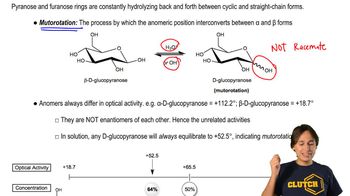
    A stereocenter in a sugar ring where interconversion between two distinct forms, alpha and beta, occurs during equilibrium.
  • Alpha Anomer

    A cyclic sugar form where the substituent at the anomeric center is trans to the CH2OH group, affecting optical rotation.
  • Beta Anomer

    A cyclic sugar form where the substituent at the anomeric center is cis to the CH2OH group, leading to a distinct optical rotation.
  • Pyranose Ring

    A six-membered cyclic structure formed by sugars, commonly seen in glucose, that can open and close during equilibrium.
  • Furanose Ring

    A five-membered cyclic structure in sugars, capable of interconverting with its straight-chain form under certain conditions.
  • Cyclization

    The process where a straight-chain sugar forms a ring structure, establishing a new stereocenter at the anomeric position.
  • Decyclization

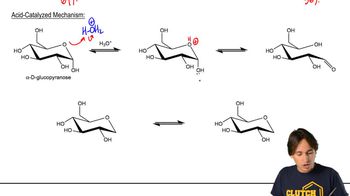
    The conversion of a cyclic sugar back to its open-chain form, allowing for reformation into different anomers.
  • Optical Activity

    A measurable property indicating how a compound rotates plane-polarized light, used to distinguish between sugar anomers.
  • Diastereomer

    A stereoisomer that is not a mirror image of another, such as alpha and beta forms of a sugar, resulting in different physical properties.
  • Equilibrium Ratio

    The proportion of alpha and beta anomers present when mutarotation reaches a stable state, unique for each sugar.
  • Protonation

    The addition of a proton to an oxygen atom in the sugar ring, initiating the acid-catalyzed mechanism for ring opening.
  • Hydronium Ion

    A catalyst in acid-mediated mutarotation, providing the proton necessary for ring opening in the sugar.
  • Chirality

    A property of a carbon atom in sugars that is temporarily lost during ring opening, allowing for reformation into either anomer.
  • Polarimeter

    An instrument used to measure the degree of optical rotation, providing experimental evidence for mutarotation.
  • Racemate

    A mixture containing equal amounts of two enantiomers, distinct from the typical alpha-beta ratio seen in mutarotation.