Back

Monosaccharides - Ruff Degradation quiz

Control buttons has been changed to "navigation" mode.
1/15
  • What is the main purpose of Ruff degradation in carbohydrate chemistry?

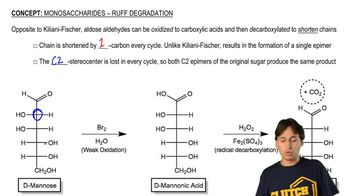
    Ruff degradation is used to shorten the carbon chain of a sugar by one carbon atom through decarboxylation.
  • Which reaction is considered the opposite of Ruff degradation?

    The Kiliani Fischer chain lengthening reaction is the opposite, as it adds a carbon to the sugar chain.
  • What is the first reagent used in Ruff degradation to oxidize the aldehyde group?

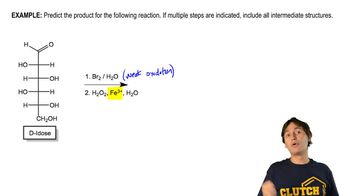
    Bromine water is used to oxidize the aldehyde group to a carboxylic acid.
  • Why is the carboxylic acid formed in Ruff degradation not easily decarboxylated?

    It lacks an adjacent carbonyl group, which makes decarboxylation more difficult compared to beta-keto acids.
  • What special reagents are required for the decarboxylation step in Ruff degradation?

    Hydrogen peroxide and an iron sulfate complex are used to facilitate the radical decarboxylation.
  • What type of mechanism is involved in the decarboxylation step of Ruff degradation?

    A radical mechanism is involved, initiated by hydrogen peroxide and iron sulfate.
  • Which carbon atom is lost during each cycle of Ruff degradation?

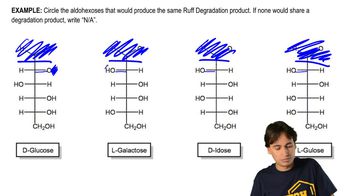
    The C2 stereocenter is lost during each cycle of Ruff degradation.
  • How does the stereochemistry of the sugar change after Ruff degradation?

    The number of chiral centers decreases, leading to a more stereospecific product.
  • What is released as a byproduct during the decarboxylation step of Ruff degradation?

    Carbon dioxide (CO2) is released as a byproduct.
  • After Ruff degradation, what functional group is present at the new terminal carbon?

    An aldehyde group is present at the new terminal carbon.
  • What happens to the last three hydroxyl groups during Ruff degradation?

    The last three hydroxyl groups remain in the same position as in the original sugar.
  • What is the degradation product of D-mannose after one Ruff degradation cycle?

    D-arabinose is formed from D-mannose after one Ruff degradation cycle.
  • How does Ruff degradation affect the number of chiral centers in a sugar?

    It reduces the number of chiral centers by one with each cycle.
  • Why does Ruff degradation produce a stereospecific product rather than a mixture of epimers?

    Because it removes a chiral center instead of creating a new one, so no new stereochemistry is introduced.
  • What is the role of hydrogen peroxide in the Ruff degradation reaction?

    Hydrogen peroxide acts as a radical initiator to help decarboxylate the carboxylic acid.