Back

Monosaccharides - Osazones quiz

Control buttons has been changed to "navigation" mode.
1/15
  • What functional group in monosaccharides reacts with Phenylhydrazine to form osazones?

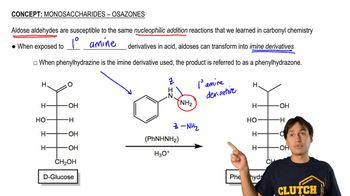
    The carbonyl group (aldehyde or ketone) reacts with Phenylhydrazine to form osazones.
  • What is the initial product formed when a monosaccharide reacts with Phenylhydrazine in acid?

    The initial product is a Phenylhydrazone derivative formed at the carbonyl site.
  • What happens when excess Phenylhydrazine is used in the reaction with a monosaccharide?

    Excess Phenylhydrazine leads to further reaction and tautomerization, resulting in the formation of an osazone.
  • How many equivalents of Phenylhydrazine are required to produce an osazone from a monosaccharide?

    At least three equivalents of Phenylhydrazine are required to produce an osazone.
  • What is the structural feature of an osazone formed from a monosaccharide?

    An osazone is a C1, C2 diphenylhydrazone derivative, meaning it has phenylhydrazone groups at both the first and second carbon atoms.
  • Why are osazones historically significant in carbohydrate chemistry?

    Osazones were used by Emil Fischer to prove the structures and epimeric relationships of monosaccharides.
  • What is the role of tautomerization in osazone formation?

    Tautomerization allows the carbonyl group to shift, enabling further reaction with Phenylhydrazine at the C2 position.
  • What is a Phenylhydrazone derivative in the context of monosaccharide reactions?

    A Phenylhydrazone derivative is formed when the carbonyl group of a monosaccharide reacts with Phenylhydrazine, resulting in a double bond between carbon and nitrogen with a benzene ring attached.
  • What is the general formula for a primary amine derivative like Phenylhydrazine?

    The general formula is NH2Z, where Z is a group such as a benzene ring attached to the nitrogen.
  • Why are osazones less commonly used in modern carbohydrate chemistry?

    Osazones are less commonly used due to their toxicity and the availability of safer, more advanced analytical methods.
  • What did Emil Fischer demonstrate using osazones in 1888?

    He demonstrated that glucose and mannose are epimers by crystallizing their osazones and comparing their properties.
  • What is the typical expectation in exam questions regarding the reaction of monosaccharides with Phenylhydrazine?

    Students are expected to show the formation of the osazone, not just the initial Phenylhydrazone product.
  • What is the mechanism complexity of osazone formation?

    The mechanism is complex and typically not required to be drawn in detail for exams.
  • What is the toxicity concern associated with osazones and Phenylhydrazine?

    Phenylhydrazine and osazones are toxic, and historical chemists like Emil Fischer suffered health consequences from exposure.
  • What is the main reason osazones are still taught in textbooks despite their limited modern use?

    They are taught because of their historical importance in elucidating monosaccharide structures before modern techniques existed.