Back

Monosaccharides - N-Glycosides definitions

Control buttons has been changed to "navigation" mode.
1/15
  • Monosaccharide

    A simple carbohydrate ring capable of forming glycosides by substitution at its anomeric position.
  • Anomeric Position

    The carbon in a sugar ring where substitution occurs, determining the alpha or beta configuration.
  • Glycoside

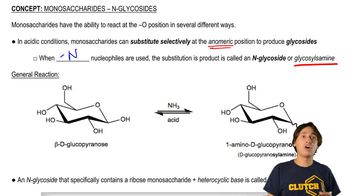
    A compound formed when a substituent replaces the anomeric hydroxyl group of a sugar.
  • N-Glycoside

    A molecule where a nitrogenous nucleophile replaces the anomeric hydroxyl group of a sugar.
  • Glycosylamine

    A sugar derivative with an amine group attached at the anomeric position, synonymous with N-glycoside.
  • Oxocarbenium Ion

    A positively charged intermediate at the anomeric carbon, facilitating nucleophilic attack during glycosidation.
  • Nucleophile

    A species, often containing nitrogen, that donates a lone pair to form a bond at the anomeric position.
  • Ribonucleoside

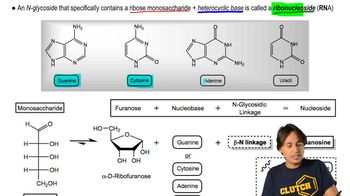
    A compound formed by linking ribose to a heterocyclic nitrogen base via a beta-N-glycosidic bond.
  • Heterocyclic Base

    An aromatic ring containing nitrogen, such as guanine, cytosine, adenine, or uracil, found in RNA.
  • Beta-N-Glycosidic Bond

    A linkage where the nitrogen base attaches to ribose with both stereochemical groups facing the same direction.
  • Ribose

    A five-carbon sugar forming the backbone of RNA, cyclizing to ribofuranose before nucleoside formation.
  • RNA

    A nucleic acid composed of ribonucleosides linked by phosphate groups, encoding genetic information.
  • Phosphate Group

    A functional group added to ribonucleosides to form the acid component of RNA.
  • Anomer

    A stereoisomer of a sugar differing in configuration at the anomeric carbon, designated as alpha or beta.
  • Furanose

    A five-membered ring form of a monosaccharide, such as ribofuranose, involved in nucleoside structure.