Back

Monosaccharides - Kiliani-Fischer quiz

Control buttons has been changed to "navigation" mode.
1/15
  • What is the main purpose of the Kiliani-Fischer synthesis in carbohydrate chemistry?

    The Kiliani-Fischer synthesis is used to lengthen monosaccharide chains by adding an extra carbon atom.
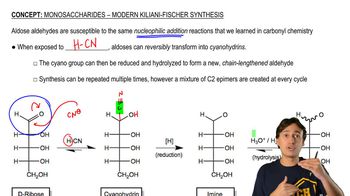
  • Which functional group is formed when an aldehyde reacts with HCN in the first step of the Kiliani-Fischer synthesis?

    A cyanohydrin functional group is formed.
  • What type of reaction occurs when CN- attacks the carbonyl carbon of an aldehyde during the Kiliani-Fischer synthesis?

    A nucleophilic addition reaction occurs.
  • After forming a cyanohydrin, what is the next functional group produced during the Kiliani-Fischer synthesis?

    The cyanohydrin is reduced to form an imine (C=NH) group.
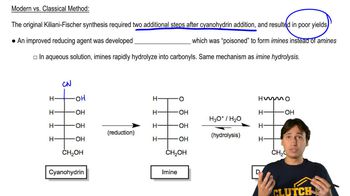
  • Which catalyst is used in the modern Kiliani-Fischer synthesis to reduce the cyanohydrin to an imine?

    A poisoned catalyst, specifically palladium on barium sulfate (Pd/BaSO4), is used.
  • Why is a 'poisoned' catalyst used instead of regular catalytic hydrogenation in the Kiliani-Fischer synthesis?

    A poisoned catalyst is weaker and prevents over-reduction, stopping at the imine stage instead of fully reducing to an amine.
  • How is the imine intermediate converted back to an aldehyde in the Kiliani-Fischer synthesis?

    The imine is hydrolyzed using water and acid to regenerate the aldehyde group.
  • What is a limitation of the Kiliani-Fischer synthesis regarding stereochemistry?

    Each new chiral center formed results in a mixture of diastereomers, so the product is not stereochemically pure.
  • Can the Kiliani-Fischer synthesis be repeated to further lengthen the carbon chain of a sugar?

    Yes, the process can be repeated multiple times to continuously extend the carbon chain.
  • What is the difference between the original and modern Kiliani-Fischer synthesis methods?

    The modern method uses more efficient reagents, such as Pd/BaSO4, resulting in better yields and fewer steps.
  • What happens to the configuration at the newly formed chiral center after each Kiliani-Fischer cycle?

    A mixture of configurations (diastereomers) is produced because the addition can occur from either side.
  • What is the role of water and acid in the final step of the Kiliani-Fischer synthesis?

    Water and acid hydrolyze the imine back to an aldehyde, completing the chain extension.
  • Why does the Kiliani-Fischer synthesis not produce a single stereoisomer at each new chiral center?

    Because the intermediate carbon is planar, nucleophilic addition can occur from either side, leading to a mixture of stereoisomers.
  • What is the functional group present in the product after the Kiliani-Fischer synthesis is complete?

    The product is an extended-chain aldose with an aldehyde functional group.
  • What is the significance of using Pd/BaSO4 in the reduction step of the Kiliani-Fischer synthesis?

    Pd/BaSO4 acts as a poisoned catalyst, allowing selective reduction to the imine without over-reducing to an amine.