Back

Monosaccharides - Haworth Projections quiz

Control buttons has been changed to "navigation" mode.
1/15
  • What is a Haworth projection used for in sugar chemistry?

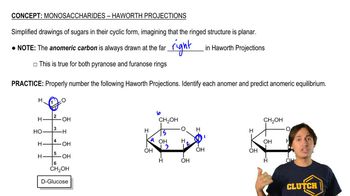
    A Haworth projection is a simplified cyclic representation of sugars, making it easier to draw their ring forms.
  • Where is the anomeric carbon always located in a Haworth projection?

    The anomeric carbon is always positioned at the far right in a Haworth projection.
  • How are carbons numbered in a Haworth projection?

    Carbons are numbered clockwise starting from the anomeric carbon at the far right.
  • Does the rule for the anomeric carbon's position apply to both pyranose and furanose rings?

    Yes, the anomeric carbon should be at the far right for both pyranose (six-membered) and furanose (five-membered) rings.
  • In a Haworth projection of D-glucose, which direction does carbon 6 point?

    In D-glucose, carbon 6 points upwards due to the D-stereo descriptor.
  • What does the D-stereo descriptor indicate about the orientation of carbon 6 in a Haworth projection?

    The D-stereo descriptor means that carbon 6 is oriented upwards in the Haworth projection.
  • How can you distinguish between the alpha and beta anomers in a Haworth projection?

    Alpha anomer has the anomeric OH group trans to the CH2OH group, while beta anomer has them cis.
  • Which anomer of D-glucose is favored at equilibrium?

    The beta anomer of D-glucose is favored over the alpha anomer at equilibrium.
  • What is the main advantage of using Haworth projections for monosaccharides?

    Haworth projections are easier to draw and interpret than the actual puckered chair conformations.
  • What is the relationship between the Haworth projection and the cyclohexane chair conformation?

    The Haworth projection is a simplified, planar version of the more accurate cyclohexane chair conformation.
  • When numbering carbons in a Haworth projection, which carbon is always number 1?

    The anomeric carbon at the far right is always carbon number 1.
  • What does a 'trans' configuration between the anomeric OH and CH2OH indicate?

    A trans configuration indicates the alpha anomer.
  • What does a 'cis' configuration between the anomeric OH and CH2OH indicate?

    A cis configuration indicates the beta anomer.
  • Is the Haworth projection an accurate depiction of the actual shape of sugar rings?

    No, it is a simplified, planar depiction; the actual ring is puckered.
  • Why might the favored anomer at equilibrium differ between sugars like glucose and mannose?

    The favored anomer depends on the specific sugar's structure; for glucose, beta is favored, but for others like mannose, it may differ.