Back

Monosaccharides - Alkylation quiz

Control buttons has been changed to "navigation" mode.
1/15
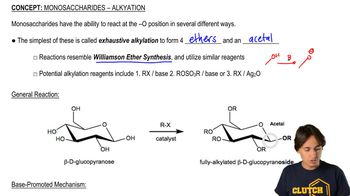
  • What is formed when monosaccharides undergo exhaustive alkylation at the O position?

    Exhaustive alkylation forms 4 ether groups and an acetal on the monosaccharide.
  • What is the key similarity between exhaustive alkylation of monosaccharides and the Williamson ether synthesis?

    Both involve deprotonating an alcohol to form a nucleophile that attacks an alkyl halide.
  • What are the three most common reagents used for monosaccharide alkylation?

    The three most common reagents are alkyl halides in base, sulfonate esters, and silver oxide.
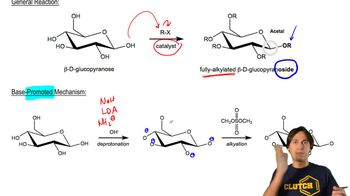
  • Why does the base-promoted mechanism allow for multiple SN2 attacks during alkylation?

    The base deprotonates the alcohols, making them strong nucleophiles that can each perform a backside SN2 attack.
  • What is the role of the base in the base-promoted alkylation mechanism?

    The base deprotonates the alcohol groups, generating nucleophilic oxygens for SN2 attack.
  • Why are primary alkyl halides preferred in the base-promoted alkylation of monosaccharides?

    Primary alkyl halides are preferred because SN2 reactions are most efficient with them, while secondary or tertiary halides are less reactive.
  • What is the function of a sulfonate ester in monosaccharide alkylation?

    A sulfonate ester acts as a good leaving group, allowing nucleophilic attack by the deprotonated alcohol.
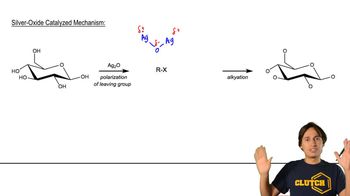
  • How does the silver oxide mechanism differ from the base-promoted mechanism in monosaccharide alkylation?

    In the silver oxide mechanism, the alcohol remains neutral and the leaving group is made more reactive, facilitating nucleophilic attack.
  • What is the final product called when an R group is attached to the anomeric carbon after alkylation?

    The product is called a pyranoside (or furanoside, depending on the ring), indicating an R group at the anomeric position.
  • How many times does the SN2 reaction occur during exhaustive alkylation of a monosaccharide?

    The SN2 reaction occurs five times, once for each hydroxyl group on the monosaccharide.
  • What is the main purpose of using silver oxide in the alkylation of monosaccharides?

    Silver oxide enhances the leaving group's ability, making the alkylation possible without deprotonating the alcohol.
  • What is the net result of exhaustive alkylation on beta-D-glucopyranose?

    The net result is a fully alkylated beta-D-glucopyranoside, with R groups attached to all oxygen positions.
  • Why is the term 'promoted' used instead of 'catalyzed' for the base-promoted mechanism?

    Because the base is not necessarily regenerated at the end, so it is not acting as a true catalyst.
  • What happens to the leaving group in the base-promoted mechanism when a sulfonate ester is used?

    The leaving group is resonance stabilized after the nucleophilic attack, making it an excellent leaving group.
  • What is the significance of the term 'oside' in the name of the alkylated product?

    'Oside' indicates that an R group is attached to the anomeric carbon of the ring structure.