Back

Molecular Orbitals quiz

Control buttons has been changed to "navigation" mode.
1/15
  • What is a sigma bond and how is it formed?

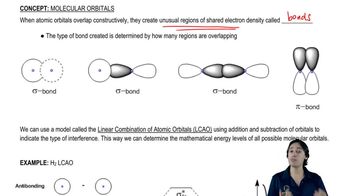
    A sigma bond is a single bond characterized by one region of orbital overlap, which can occur between s-s, s-p, or p-p orbitals.
  • How does a pi bond differ from a sigma bond in terms of orbital overlap?

    A pi bond involves two regions of overlap, typically formed between two p orbitals, whereas a sigma bond has only one region of overlap.
  • What is the Linear Combination of Atomic Orbitals (LCAO) model used for?

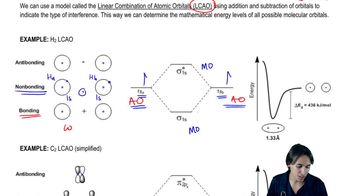
    The LCAO model is used to predict molecular orbitals by combining atomic orbitals to describe electron behavior in molecules.
  • What is the difference between bonding and anti-bonding molecular orbitals?

    Bonding orbitals result from constructive interference and lower energy, while anti-bonding orbitals result from destructive interference and have higher energy.
  • What does the star symbol (*) indicate in molecular orbital diagrams?

    The star symbol denotes an anti-bonding orbital, which is higher in energy and less stable.
  • Why are anti-bonding orbitals energetically unfavorable?

    Anti-bonding orbitals are energetically unfavorable because they require electrons to occupy higher energy states, making the molecule less stable.
  • What happens to the energy of a molecule when two hydrogen atoms form a sigma bond?

    The energy of the molecule decreases significantly, making the bond formation highly favorable and stable.
  • How many regions of overlap are present in a pi bond?

    A pi bond has two regions of overlap, typically above and below the plane of the atoms involved.
  • What is the typical bond length of a sigma bond between two hydrogen atoms?

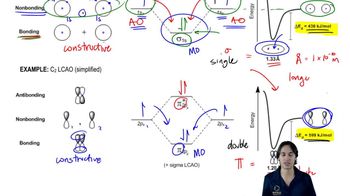
    The bond length is about 1.33 angstroms, which is a very small unit of measurement (1x10^-10 meters).
  • What is the main energetic advantage of forming a sigma bond between two hydrogen atoms?

    Forming a sigma bond saves about 436 kilojoules per mole, making the molecule much more stable.
  • What is the composition of a double bond in terms of molecular orbitals?

    A double bond consists of one sigma bond and one pi bond.
  • Which type of bond, sigma or pi, contributes more to the strength of a double bond?

    The sigma bond contributes more to the overall strength and stability of a double bond.
  • What is a non-bonding orbital and when does it occur?

    A non-bonding orbital occurs when atomic orbitals do not interact, resulting in no shared electron density between atoms.
  • How does the energy saved by forming a double bond compare to a single bond?

    A double bond saves more energy (about 599 kJ/mol) compared to a single bond (about 436 kJ/mol), due to the additional pi bond.
  • If asked which is stronger, a double bond or a single bond, what should you answer and why?

    A double bond is stronger because it consists of both a sigma and a pi bond, providing greater overall stability.